
Aspen’s ‘snow farming’ success story
share
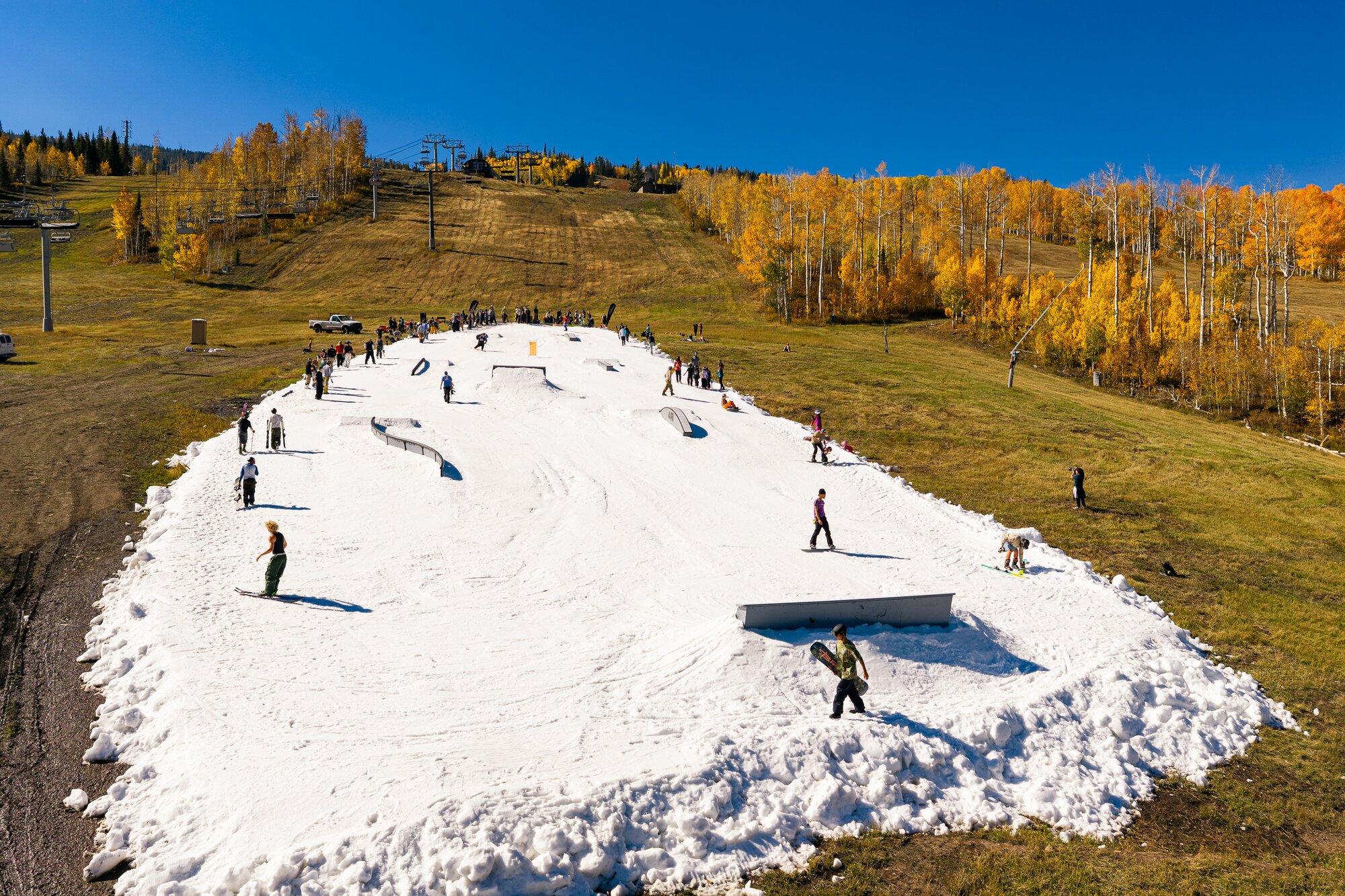
DENVER — Snowboarders doing backflips is a common sight at Makaha Park, a terrain section of Aspen Snowmass that has more than 20 ramps and rails.
What’s unusual is seeing that happen in early October, when the trees lining the mountain are still a vibrant mix of oranges and yellows.
Snowmass opened a section of the terrain park Oct. 3. Skiers and snowboarders hiked up the slope before barreling down what they called a “creamy,” “dope” and “electric” section of actual snow.
The winter snow survived the summer thanks to technology called Snow Secure, massive insulated blankets that covered millions of gallons of snow for about four months. Snowmass is the first Colorado ski area to use the Finnish snow storage system, which is also in place at Burke Mountain in Vermont, Soldier Hollow in Utah and several other ski areas in North America and Europe. The process is sometimes called “snow farming.”
Chris Miller, the senior vice president of sustainability at Aspen One, Snowmass’ parent company, described Snow Secure — which Time Magazine listed as one of the best inventions of 2025 — as “pretty basic technology.” The roughly 3-inch-thick blankets are made of the same material used for home insulation in Scandinavia, Miller said.
“One of the main reasons that we are moving in this direction is, essentially, to build a toolbox of tools that make us more resilient in the face of a changing climate,” Miller said.
Snowmass’ trial with Snow Secure came after the worst snowpack on record in Colorado followed by the state’s hottest-ever summer. Even so, the blankets retained 85% of the snow beneath, Miller said. Internal snow temperatures averaged just above freezing, even when the surface temperature of the blankets broke 100 degrees.
Miller said plans to test Snow Secure at Aspen started before last winter’s disappointing snowpack. But the fact that it was successful during an extreme year gives Aspen confidence to expand the use of Snow Secure moving forward, Miller said.
“And while we don't believe that last winter is the new normal for the Mountain West … it does give us a peek into the variability of the climate and what we can anticipate over time,” he said.
Climate change could shorten ski seasons by more than half by 2050, research shows. The Snow Secure trial is the latest example of Colorado ski areas working to become more resilient in the face of less predictable and warmer winters, which experts say are the result of human-caused climate change. In 2023, Aspen opened a new section of the mountain called Hero’s, a high-elevation, north-facing section that is more climate-proof than the rest of the resort. Other major resorts like Vail and Beaver Creek use automated snowmaking systems, which are more efficient.
Since this trial run was a success, Snowmass plans to use more blankets this coming season, Miller said. In the future, the ski area will preserve the snow under the blankets until temperatures drop and then use it as an early season base of snow to build upon. Because this year’s pile of snow was relatively small in its footprint, Miller said, they decided to open the terrain park and “have a little bit of fun, [especially with] the season we had last year.”
Type of story: News
Based on facts, either observed and verified firsthand by the reporter, or reported and verified from knowledgeable sources. To read more about why you can trust the journalism of Rocky Mountain PBS, please visit our editorial standards and practices page.
Based on facts, either observed and verified firsthand by the reporter, or reported and verified from knowledgeable sources. To read more about why you can trust the journalism of Rocky Mountain PBS, please visit our editorial standards and practices page.