
Rural Coloradans wait decades for clean drinking water: 'I never thought I'd have to haul water in America'
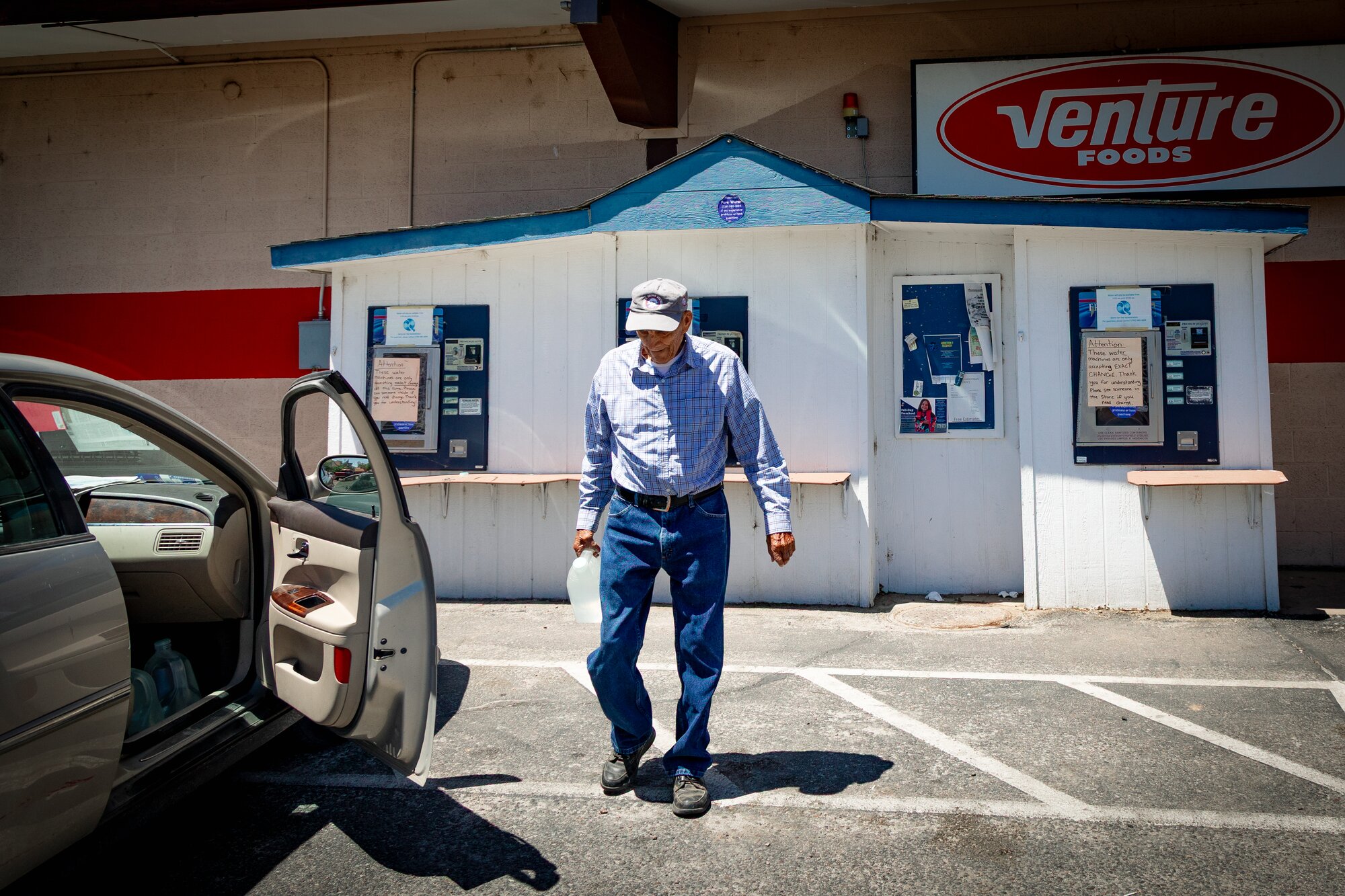
ROCKY FORD, Colo. — A 94-year-old veteran steps out of his tan Buick sedan at the water station by the Rocky Ford Food Market, an empty gallon Arizona Iced Tea jug in hand. He walks to a water machine, inserts 35 cents into a slot, and watches as filtered water rushes out to fill the jug.
He repeats the process four times before loading several jugs into his car for the nine mile drive home to Manzanola just northwest of Rocky Ford.
For Jose Martinez, this is a weekly routine.
Martinez and his family use the water from this station for cooking and drinking. He hasn't tasted the water from his tap in years. The City of Manzanola has sent him enforcement notices warning that his tap water contains elevated levels of radium.
“We can't cook any beans with it because it turns black,” he said about his tap water.
Like Martinez, thousands of residents in communities across Colorado’s Lower Arkansas Valley haul water from water stations to their homes, a routine necessitated by decades of poor drinking water quality in the region.
Rocky Mountain PBS is premiering “Pipe Dreams: The Wait for Clean Water” Thursday, July 30.
“As far back as 1930, there was a realization that the water quality in the lower Arkansas Valley… was questionable and not necessarily desirable, but people lived with it,” said Bill Long, president of the Southeastern Colorado Water Conservancy District.
Within a span of approximately 100 miles along the Arkansas River east of Pueblo, 17 communities are in violation of the Safe Drinking Water Act, which means their water does not meet national standards for safe drinking water. Colorado’s Department of Public Health and Environment regularly monitors and reports on the safety of the water.
A fix for the region’s water challenges has been more than 60 years in the making — and still isn’t ready.
Communities along Colorado’s Lower Arkansas Valley rely on groundwater wells for drinking water. Some draw from deeper wells that tap into shale formations, which carry higher levels of naturally occurring radioactive elements including uranium, radium and radon, according to Chris Woodka, senior policy and issues manager for SECWCD.
Drinking water with high levels of these contaminants over a long period of time can increase the risk of cancer and kidney problems, said Tiffany Sanchez, an assistant professor of epidemiology at Colorado School of Public Health.
Other communities in the region rely on shallow wells, which have higher levels of salinity, iron and manganese, along with increasing contamination from PFAS, or forever chemicals, that affect the taste and quality of the drinking water.
In 1962, President John F. Kennedy signed the Fryingpan-Arkansas Project Act, known as the “Fry-Ark,” to bring water from the Western Slope to Colorado’s Arkansas River basin to the east.
The series of infrastructure projects would provide supplemental water for irrigation and municipal and industrial uses and would serve as a steady, reliable stream of water to help manage flooding and drought, according to Woodka.
As one part of the act, Congress authorized the Arkansas Valley Conduit — a 130-mile pipeline designed to deliver clean drinking water to 50,000 people across nearly 40 communities.
However, unlike most of the other projects in the 1962 act, the communities in this region would have to bear the full cost of the project themselves, without federal assistance.
While the rest of the Fry-Ark projects were completed by 1990, the Arkansas Valley Conduit project stalled for more than six decades because of local communities’ inability to cover its costs, according to the SECWCD.
“It's a rural area. The communities are spread out and you have to build long pipelines between the communities to get a good system,” said Woodka.
“And that's expensive.”
In 2009, Congress amended the original legislation to establish a cost-sharing plan where the federal government would cover 65% of the costs and local communities would cover 35%.
But the funding was slow to come. Over the years, Congress allocated about $3 to $5 million a year, Woodka said.
When President Joe Biden signed the Infrastructure Investment and Jobs Act in 2021, however, the project got a windfall: $500 million dollars over the course of several years. The Arkansas Valley Conduit broke ground in 2023, and since then, the SECWCD and the federal government’s Bureau of Reclamation have built about 12 miles of the pipeline.
A hurdle emerged in 2025 when inflation and design changes pushed the estimated cost of the project from $600 million to $1.39 billion, according to federal and local estimates.
That same year, President Donald Trump vetoed the bipartisan Finish the Arkansas Valley Conduit Act Dec. 31. Congress did not override the veto. If passed, the bill, sponsored by Colorado Rep. Lauren Boebert, a Republican and longtime supporter of Trump, would have reduced the financial burden on local communities by cutting the interest rate in half — from 3% to 1.5% — and extending the repayment period from 50 to 75 years.
Currently, the SECWCD says the current federal funding, totaling about $613 million, is enough to complete only half of the conduit, from Boone to Manzanola. The remaining stretch from Manzanola to the planned endpoint in Lamar remains uncertain.
“The project is dependent on federal funding and how soon and how quickly we can get the federal funding to do it,” Woodka said. “We're anticipating that [the Bureau of Reclamation] will get more funding.”
Boone and Avondale, the first two towns on the pipeline, are expected to be the first to receive water, with deliveries anticipated as early as 2027.
Some residents, instead of waiting for the pipeline to arrive, have turned to alternative solutions.
Shanna Riley lives off a country road between Swink and La Junta, more than 10 miles east of where the pipeline would currently end with available funding.
“The water is just not safe to drink,” Riley said.
A year ago, Riley installed a reverse osmosis and triple filtration system in her home, costing her family $10,000, which she is still paying off. Reverse osmosis is a treatment process that removes contaminants such as radionuclides, lead, arsenic, bacteria and viruses.
Many residents in the region, where the median household income is $54,000, cannot afford individual filtration systems.
“They tell people, get a reverse osmosis system on their own dime. I can't afford to go get a reverse osmosis system,” said Robert Smith, who gets his water from West Grand Valley Water, one of the water authorities that is under enforcement orders for high levels of radium.
As an avid gardener, Smith said this is the first year he hasn't felt good about growing vegetables.
“I like sharing it with friends and family. And they all have kids. Can I, with good conscience, give the kids vegetables grown as watered by the water around here?” Smith said.
Two towns in the region, Las Animas and La Junta, currently use reverse osmosis to treat their water. They’ve provided residents with clean drinking water for decades as the municipalities have waited for the conduit construction.
However, the treatment process creates a new environmental challenge.
Reverse osmosis extracts concentrates of contaminants from the well water and those contaminants need a place to be discharged. Currently, the two towns discharge the contaminants into the Arkansas River at a higher level than state regulations, though they’re permitted to do so through a special variance from the Colorado Department of Public Health and Environment.
“That variance is not in perpetuity,” Long said. “We have probably the best water in the Arkansas Valley right now, but the reverse osmosis operation cannot be a long term solution. There is a requirement [from CDPHE] to discontinue that practice.”
Long says the Arkansas Valley Conduit is the only-long term solution to address water quality issues in the region.
“Rural America is still an important part of our country and in my view, it is in some ways being neglected,” Long said.
“If the Arkansas Valley Conduit was not an option, people could continue to buy bottled water,” Long said. “People could continue to haul water, but that's what people in third world countries do.”
Based on facts, either observed and verified firsthand by the reporter, or reported and verified from knowledgeable sources. To read more about why you can trust the journalism of Rocky Mountain PBS, please visit our editorial standards and practices page.