
'Everyone has an opinion': The tricky business of managing Colorado’s moose population
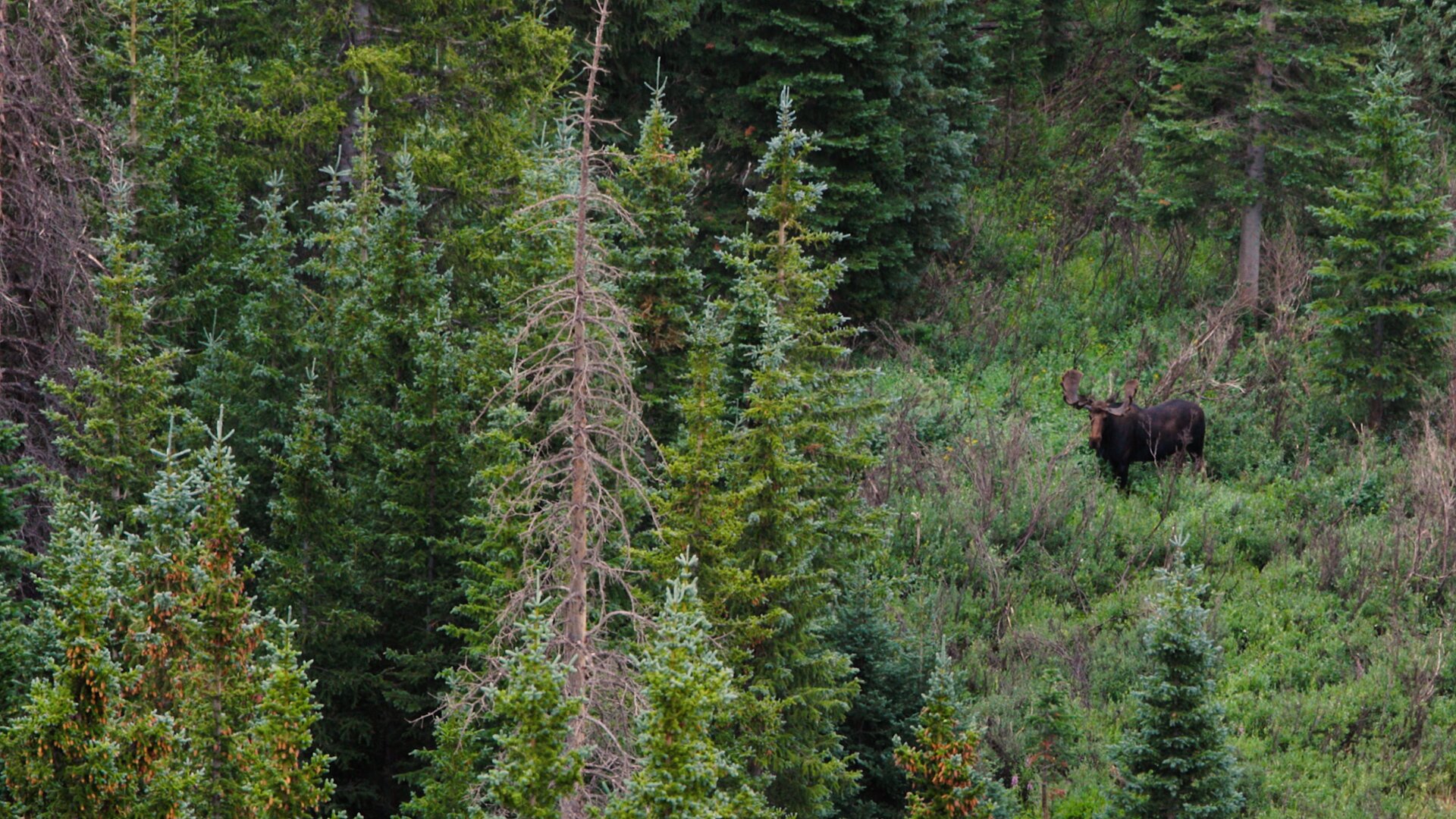
KAWUNEECHE VALLEY, Colo. — Littered across a field on the west side of Rocky Mountain National Park are what look like bundles of sticks jutting from the ground. Scientists call these “zombie willows,”and the long-lasting impacts are just as scary as the name.
Willows are the foundation of wetland ecosystems. These wetlands serve as the headwaters of the Colorado River, which supplies water for millions of Americans. While many factors have contributed to a 98% loss of tall willows since 1999, moose shoulder most of the blame.
“Moose moved into the park from the west, and their populations have been high on the west side of the park for a longer period of time,” said Will Deacy, a large mammal ecologist with RMNP.
A single moose can eat up to 60 pounds of willow a day during the summer. It would take 15 elk to eat the same amount. The “zombie willows” are what happens when moose and elk eat willows so thoroughly that the plants lose the ability to grow new leaves.
“This is the way things are functioning using [current] ecosystem services and characteristics that might take decades to recover, if they can be recovered,” said Jeremy Shaw, a wetland research scientist with Colorado State University.
RMNP has been raising the alarm about this issue for years.
In 2008, the park released a 20-year Elk and Vegetation Management plan to address some of the wetland degradation. The plan involved three major actions — installing tall fences to keep elk out of some wetland areas, planting new willows, and culling some of the elk. RMNP killed a total of 131 elk from 2009 to 2011 within park boundaries.
Now the park is working on a similar plan for moose. Surveys conducted in 2020 and 2025 showed the park’s population had grown to 240 moose, a nearly 50% increase in five years. While park officials aren't ready to release details of that plan, similar tools are likely to be considered.
Rocky Mountain PBS has been following moose management in Colorado for months, trekking to some of the most remote parts of the state. The reporting culminates in “Managing Moose: Colorado’s Most Dangerous Animal,” a new documentary premiering Sept. 17 at 7 p.m. on Rocky Mountain PBS, RMPBS+ and YouTube.
William Taylor, an associate professor at University of Colorado, Boulder sees this moose problem at RMNP as very similar to the elk.
“The elk were removed and the problem didn't go away. I think it's clear to me as well that our national park ecosystems are a little out of whack,” said Taylor, who is also curator at the school’s natural history museum.
Perhaps one of the trickiest parts of managing moose in RMNP, Taylor said, is that their natural predators — such as grizzly bears and gray wolves — have not been in the area for more than 100 years. The park estimates there are only 25 to 30 black bears living in the park, and newly reintroduced wolves have not established a population in the park.
“I think the Rocky Mountain [National Park] has some choices to make about how they navigate moose,” said Taylor.
How we got too many moose on the loose
Prior to the 1990s, people in Colorado only recorded rare instances of moose. Scientists attributed those sightings to natural migration from Wyoming.
The Colorado Division of Wildlife, the predecessor to Colorado Parks and Wildlife, brought 215 moose from neighboring states to western Colorado on several occasions between 1978 and 2010. However, ranchers, worried that the moose would compete with their sheep and cattle for grazing, gave strong pushback.
Still, the Division of Wildlife continued to advocate for bringing moose into Colorado, saying there was an abundance of habitat for them. In the 1960s, the state started working with federal partners to make these transfers possible.
“Everybody loves moose. And so there was an interest in having moose brought back both for the hunting opportunity and for the wildlife viewing opportunity,” said Andy Holland, the current big game manager for CPW.
In the winter of 1978, the Division of Wildlife brought in 12 moose from Utah to Colorado. Another 12 came from Wyoming at the beginning of 1979. All the animals were released in the North Park area of Colorado. Since then, their population has flourished.
Moose Population Boom
“It's God's country up here,” said Nadia Louise “Tootie” Crowner, the former mayor of Walden, Colorado, where she has lived her whole life.
“The natural habitat up here is very strong … I don't care if it's cattle, sheep, moose, [everything] does really well because of the nutrition that's in the wild native hay and grass,” said Crowner.
As soon as wildlife managers released the first moose in North Park, which includes Walden, in 1978, the moose thrived. A 1988 study titled “Colorado Moose: Reintroduction and Management” found that by 1980 the calf-cow ratio averaged 95 calves per 100 cows. By fall of 1980, there were 58 moose in North Park. And by 1988, there were about 250 moose statewide despite the illegal killing of 40 moose during that time period.
In the mid-90s, when Crowner was mayor, she and others had an idea to save the small and struggling town. Walden had seen different industries come and go. Mining, logging and ranching were on the decline and many people had moved away from the area. In 1990, the National Association of Counties listed the town as one of the most endangered towns in the United States.
“The biggest thing was to capitalize on [having the moose here] to help the struggling community, which it did,” said Crowner.
In 1995, the Colorado Legislature declared Walden, the only incorporated town in Jackson County, the “moose-viewing capital of Colorado.”
“[A] huge part of what happens with the wildlife and recreation up here is the money that's created from the sales tax in this town,” she said.
Since 2000, the moose population has tripled in the state, with moose spreading to new areas. The current moose population estimate from CPW is 3,400.
“Moose have shown us that much of Colorado, particularly the central Rocky Mountain span of Colorado, much of that is excellent moose habitat,” said Holland.
Colorado’s Most Dangerous Animal
CPW provided data on moose, mountain lion and bear attacks from 2019 to 2025. In four of the seven years of data presented, moose had the most attacks in the state. The data only include the attacks reported to CPW, like the one Chris Ray survived in 2023.
Ray, a pika researcher with the University of Colorado, has lived at 9,000 feet in Boulder County for more than 20 years. Moose often wander by her home, and she regularly sees them while conducting field research. She didn’t fear the animal until the morning of Sept. 20, 2023.
Ray used to take her dog, Nala, on walks using a leash along the South Saint Vrain Trail every morning. At the bottom of the trail, Ray would fill a big jug of water from the river and stick it in her backpack.
About 15 minutes into her hike, she heard something cross the creek but couldn’t see it because thick brush and trees blocked her view. But then she heard a grunt. She turned around to see a cow moose charging toward her and her dog.
“I just turned around, said ‘No!’, and went for the nearest tree. And I fell flat on my face because I tripped over some barbed wire that was next to the trail that I didn't realize was there, and I thought, ‘Well, she's going to be on me … maybe this is it for me,’” said Ray.
The moose stomped on Ray’s back, landing three of her four hooves on her water-filled backpack. But the moose wasn’t done. She wheeled around a second time to stomp Ray again.
This time Ray put her arm over her head and the moose stomped her arm and leg. Ray was able to scramble behind the tree she was aiming for, but the moose still wasn’t done.
“I tried to pull Nala, my dog. I tried to pull her and I couldn't because the leash was wrapped around maybe the barbed wire, but definitely a little tree,” said Ray.
“And I thought, now I get to watch the moose kill my dog. And it was worse than anything I could imagine. I was just hopeless.”
Nala was able to sidestep the charging moose at just the right time to avoid attack. Nala did that three times. After the final miss, the moose trotted back across the creek.
“My mind was just blown that … we were so far from that moose. We were on the other side of a creek, and yet she still felt so threatened that she needed to take us out,” said Ray.
Ray was able to stabilize herself and walk down the trail to a neighbor’s house where she collapsed just after she crossed the doorway.
Doctors told Ray the moose broke her back in three places, along with a rib and her sternum. She also had a nasty bruise over her kidney, but no permanent damage. Three years later, she finally feels fully recovered and grateful — but also fearful.
“I was just so incredibly lucky, just lucky that I was carrying that water,” said Ray.
“I just used to find solace in nature, and I now have fear, which is a real bummer. But I certainly don't blame the moose for that.”
Moose’s anti-predator strategy is to stand their ground and use their hooves to stomp whatever is in their way.
“[Moose] look kind of dumb and docile, but don't let that fool you, that's just how they deal with threats,” said Holland.
“A cow moose with a calf … will aggressively defend that calf, and so they're the most dangerous animal in Colorado.”
Holland said most conflicts with moose happen when there is a dog present as moose often see dogs as wolves or similar type of predator. His best advice for people is to keep their dog on a leash and keep their distance from a moose.
Are moose native to Colorado? Does it matter?
As conflicts with humans increased and willow degradation in RMNP continued, some scientists and media outlets pointed out that the animal has long been considered non-native. This is where William Taylor came in.
“Based on my body of knowledge as an archeologist, my job here in the museum was immediately sort of curious and a little skeptical of [moose being non-native],” said Taylor.
He also knew about what happened with mountain goats in Olympic National Park. The National Park Service considers the animal non-native to the area and says a sportsman group introduced them in the 1920s. Over time, the population grew and had measurable negative effects on the ecosystem and proved dangerous to humans. It’s a story that sounds very familiar to Taylor.
“The word invasive is not just a pejorative adjective in the U.S., it means you can do extreme sort of, no holds barred and difficult-to-come-back-from management choices,” said Taylor.
In Olympic National Park, wildlife managers developed a Mountain Goat Management Plan to completely remove goats from the Olympic Peninsula. The first phase of the plan transferred 90% of the mountain goats to the Cascade Range, and then the park killed what was left — more than 200 goats.
“I think [that] is the most obvious example of a larger trend in which, especially rare or difficult to encounter species … And, probably lived in low numbers at the time that parks were founded has sort of been misunderstood as animals that don't belong,” said Taylor.
Most national parks were established in the early 20th century after decades of unregulated hunting and, in some cases, the eradication of animals in certain areas like bison or gray wolves. Taylor believes the founding of our national parks happened at a time where the parks’ ecologies were “deeply, deeply destabilized.”
He worries that RMNP might do to moose what Olympic did to the mountain goats. Taylor hopes that finding the true history of moose in the state, that a “native” label for the animal could prevent a situation like in Olympic National Park.
To investigate moose nativity in Colorado, Taylor and other scientists and experts documented moose sightings in historical archives, examined ethnohistoric sources, and identified moose bones found in archaeozoological sites in Colorado. Taylor and his team published their findings in June in the Journal of Biogeography. Three anonymous peer reviewers and an editor with the journal examined the study before publication.
One of the archaeological records comes from a dig site in Weld County, Colorado called the Jurgens site. Scientists identified two 9,000-year-old moose bones from the site. Another record Taylor cites in his paper is a moose hide stored among the Denver Museum of Nature and Science’s collection. It came from a moose that a hunter mistook for an elk and killed near Grand Lake in 1944. The study also uses a number of written archives including newspapers from 1860 up until 1968. Many of the newspaper mentions of moose are brief sightings. However, Taylor also believes Native American histories point to the animal being part of Colorado’s landscape.
“The most obvious source of knowledge that has not been tapped into … is tribes,” said Taylor.
Crystal C’Bearing is an author on the study and is the tribal historic preservation officer for the Northern Arapaho tribe. She provided Arapaho designs and symbols that represented moose including a moose hide drum.
“Moose are so huge, and they provide a lot of meat. So just getting one moose like that, how many people can that feed? That can feed a lot, a whole band at one point. Right now, it can feed our families for like the whole year,” said C’Bearing.
She said Arapaho culture always finds a way to use all parts of an animal like a moose or buffalo. The word for moose in Arapaho is “hinenihii.” C’Bearing said the word means “he’s like a big man.”
“Do I believe that moose were here in the southern Rockies? I believe so,” said C’Bearing.
“[From] native viewpoints and perspectives things come in a cycle. There's different things that we have in our stories that talk about different time periods and things coming back. So, you can always say that moose probably weren't here at one time, but then they came back, and then they left again for whatever reason.”
Taylor’s study concludes that there is a “robust historic record with moose” in the Southern Rockies and that it is “scientifically inaccurate to frame moose as ‘non-native.’” However, RMNP still believes that moose did not have a “sustained breeding population” in Colorado prior to the transfer of animals in the late 1970s.
“‘What do we mean by native? Do we mean over the last 200 years or over the last 20,000 years? Do we mean the borders of Rocky Mountain National Park or Colorado or the Rocky Mountains? And then what is the definition of residents?’” said Will Deacy, an RMNP large mammal ecologist.
“So whenever anybody says that a species is native, it's important to ask those questions.”
Despite a disagreement on the historical record of moose in Colorado, RMNP has reiterated in several instances that this debate does not impact their management decisions with moose today.
“[Nativity] is not a very useful concept for our management, because we're really focused on what is the effect of the species in the environment,” said Deacy.
“We're more so concerned about addressing the ecological impact rather than getting into the weeds too much exclusively about whether a species…had a large population or small population. It's really about the effects that occurred on the landscape and how we have to manage these ecosystems,” said Isabel de Silva Shewell, an ecologist with RMNP.
But RMNP Taylor, and others can agree on one thing: the top predators for moose have been removed from this equation in the park, including humans. When the United States established Rocky Mountain National Park in 1915, Congress included a ban on hunting, so changing it would require an act of Congress, creating another management challenge for RMNP.
What to do with moose
From a statewide perspective, Holland said Colorado's moose population is finally leveling out, with the current estimate at 3,400. He attributes the ability to control the population and keep sensitive willow and aspen communities from being overbrowsed to the state’s hunting program.
“We've increased our cow moose hunting licenses fourfold in the last 13 years,” said Holland.
The CPW Commission approved plans for this year’s September and October moose hunting season in May. CPW distributed 761 licenses — 438 cow and 323 bull — across 74 game management units. CPW has divided the state into a total of 185 GMUs, which allows the state to examine each area more closely to determine how many licenses should be allotted to each GMU based on animal populations, the human population, and the status of the ecology in that area.
“It's essentially the Powerball of big game hunting to draw a bull moose license. This year, we had 66,000 applicants for those 761 licenses,” said Holland.
While there are small fees to pay up front, hunters only pay the moose hunting license price of $385.66 for Colorado residents and $2,823.53 for out-of-state hunters if they are selected in the hunting-license lottery. CPW also attributes hunting and fishing dollars as major funders for a lot of their work with wildlife. In fiscal year 2024-25, hunting and fishing licenses, park passes, fees and permits made up 58% of CPW's $378 million in revenue.
“Hunting is conservation,” said Scott Limmer, a big-game hunting guide in Northern Colorado working his 36th season.
“Without hunting in Colorado, the animals could have become overpopulated over time for the amount of habitat we have left.”
In addition to quadrupling its moose hunting licenses, CPW also increased the number of GMUs that allow moose hunting from 39 to 74 in that same 13-year period.
“There's biological and social factors to consider in addition to not over-browsing our habitat. There’s also a conflict component with moose,” said Holland.
Holland said CPW uses information from field staff, specific studies on populations like one that just finished in the North Park area, and from the hunters themselves. Each moose hunter must fill out a field report and submit the head of the animal they killed to CPW for analysis.
“So those are also aspects of our harvest or herd management plans,” said Holland.
“There's a lot of social aspects of wildlife management, of who we're managing for and why. And everybody has an opinion on wildlife management. And I think everybody thinks their opinion is the best one. And if everybody thinks their opinion is the best one, clearly that can't be accurate.”
With moose populations leveling out across the state, CPW doesn’t expect to significantly change the number of moose hunting licenses, but Holland said it is the most useful tool in managing the number of moose.
Without this tool available in the park, wildlife managers have turned to other tools like fencing or organizing culling, also known as lethal removal. In 2020, a group called the Kawuneeche Valley Restoration Collaborative formed with the goal of restoring the important wetlands in the Kawuneechee Valley on the west side of RMNP.
To demonstrate the power of simple fencing, the KVRC highlighted the Holzwarth Historic Site where crews installed 16.5 acres of tall-fencing to keep elk and moose away from these willows. In the 15 years since the fence was installed, the willows have made significant recoveries. The willows have grown so thick and tall that walking through the area now requires some grit.
Based on facts, either observed and verified firsthand by the reporter, or reported and verified from knowledgeable sources. To read more about why you can trust the journalism of Rocky Mountain PBS, please visit our editorial standards and practices page.