
Handmade tortillas are at the center of Denver’s culinary ascension
DENVER — The Mosaic Community Campus, occupying 25 acres on the eastern edge of Denver’s Park Hill neighborhood, feels like a Hollywood set for a college movie. A bronze statue of a wildcat overlooks a verdant quad that is pockmarked by disc golf baskets. There’s a garden, a bookstore and a 72-foot-tall carillon that periodically chimes above the steady traffic on Quebec Street. But there are no professors or co-eds here. The dorms are now affordable housing units. A Protestant church worships in the former bookstore on weekends.
Founded in the late 19th century as the Colorado Women’s College, the campus changed hands multiple times over the decades after never quite reaching its lofty goal to become the “Vassar of the West.” Johnson & Wales, a private university with multiple campuses known for their culinary programs, purchased the Park Hill campus in 2001. It closed 20 years later, during the COVID-19 pandemic, but the culinary infrastructure remained. The campus' owner, Urban Land Conservancy, now leases the kitchens for jobs training, small business development and commissary kitchens.
This is where I met Julian Salas. He spends more than 70 hours a week in one of the Mosaic kitchens, arriving most days around 4 a.m. and rarely leaving before 5 p.m. Salas, 31, is the founder of Don Zorros Molino, a tortilla business he started three years ago with his wife, Christina.
In 2022, Salas moved his family from his hometown of Chicago to Denver in search of, he said, a safer place to start and raise a family (they now have two sons). Salas got a job at the Mexican restaurant My Neighbor Félix. Building on skills he first learned from his grandmother, Salas started making corn tortillas from scratch at home, using a countertop, hand-crank mill (molino, in Spanish) to turn corn into masa, the dough he would press and cook into tortillas. He shared the tortillas with his coworkers, who began placing orders.
“I had people say, ‘Hey, bring me 5 pounds for tomorrow,’” Salas said. In less than a year, he had a steady customer base and was fielding orders from other chefs for their restaurants. It became time to turn his hobby into a business.
Today, Salas is part of a growing number of Denver chefs producing corn tortillas from scratch, work that is steering the conversation around the city’s Mexican cuisine away from the kitschy (Casa Bonita) and colossal (Chipotle), and toward something more classic. These chefs and their handmade tortillas have brought significant attention to the city’s ascendant food scene, from nationwide best-of lists to Michelin stars.
For too long in the United States, tortillas were viewed as a vehicle to eat something else more interesting, more flavorful, said chef Jose Avila, owner of the Denver restaurant La Diabla. People treated tortillas like an edible utensil, he said, instead of the delicious foundation of a meal that it is.
“It's like your favorite painter saying, ‘I'm gonna do this mural. But I don't have a wall,’” Avila said. The tortilla is the wall. You can’t make a proper meal — the artwork — without it, he said.
Historically, corn tortillas were not a big part of the Denver diet. The city’s Mexican food scene was dominated by the oversized, the offbeat and the messy. The same can be said about the rest of the state — slopper, anyone?
“I’ve been in Denver for a long time and that was the thing: we always complained about tortillas,” Avila said. “I would ask my family to ship me [corn] tortillas from [Mexico City]. Because here, it wasn’t a thing.”
Avila moved from Mexico City to Denver in 2001. He worked in construction with his uncle for a week, hated it and applied for a job at a Mexican restaurant in Cherry Creek. The food was completely foreign to him. Growing up in Mexico City’s Iztapalapa borough, he never saw burritos the size of Nalgenes.
Denver’s Mexican food is heavily influenced by the cuisine of northern New Mexico and southern Colorado, where green chiles and flour tortillas reign supreme. When Spanish colonizers arrived in the region in the 16th century, they introduced wheat, which was easier to cultivate in high altitude desert areas than corn. This gave rise to flour tortillas, said Antonia Velasquez with the Fort Garland Museum & Cultural Center in Costilla County, Colorado. Hispano families in southern Colorado — many of them farmworkers, sheep herders and cattlemen looking for work — traveled north, Velasquez said, bringing their culinary traditions to Denver and beyond.
“I wouldn't consider it Mexican food. It's got its own style,” Velasquez said. “It's different from what you would find at, you know, a more traditional Mexican restaurant.”
Gustavo Arellano, the author of “Taco USA,” was likely the first to call that style “Den-Mex,” according to Westword, where Arellano’s syndicated “¡Ask a Mexican!” column ran for years. Arellano, an authoritative voice on Mexican food but not a purist, exalts regional specialties and north-of-the-border novelties. In 2021, he told the City Cast Denver podcast that one of his favorite "Den-Mex" plates is the signature dish at La Fiesta, the oldest family-run Mexican restaurant in Denver. It’s a chile relleno. Classic, right? Not really. Theirs come fried in a wonton wrapper and smothered in green chile.
Another Den-Mex classic comes from the Original Chubby’s, which turns 60 next year. They birthed the “Mexican Hamburger,” a beef patty stuffed inside a thermos-sized burrito. It, too, is served submerged in a puddle of green chile.
During a press tour for “Taco USA,” Arellano told The New York Times that Chubby’s “hamburger” is the dish that “best personifies the Mexican-American experience.” That was nearly 15 years ago. Chubby’s and La Fiesta have barely changed. What has changed is Denver’s gastronomic reputation, especially when it comes to Mexican food, as chefs like Avila concentrate on corn.
More tortillerias is good news for Salas at Don Zorros Molino. Denver, he told me, is “behind on a couple of things” when it comes to Mexican food — the lack of fresh corn tortillas his chief concern. He described his hometown, Chicago, as a “tortilla town.” It is home to one of the largest Mexican communities in the country, and locally owned molinos producing fresh tortillas are abundant. Salas was surprised to learn that was not the case in Denver.
“We kind of took it for granted when we moved out here. I was looking for tortillas,” he said. “You really can't find anything outside of, like, Raquelitas and a couple other places.”
Sal De La Torre founded Raquelitas in 1960. It started as a small bakery on Larimer Street. Today, the family-owned company’s output is staggering. Raquelitas has partnerships with food distribution giants like Sysco and Shamrock Foods and claims to produce half of “all tortillas and chips enjoyed at restaurants, hotels, schools, and stadiums in Colorado.” (But even Raquelitas is returning to its artisanal roots.)
Salas took it upon himself to expand Denver’s tortilla market. Don Zorros Molino produces thousands of tortillas every day. Salas provides white, yellow and blue corn tortillas to more than a dozen Colorado restaurants. He also sells his product at the City Park Farmers Market and hosts occasional pop-ups at the Mosaic campus, slinging quesabirria. In the past, he supplied tortillas to Johnny Curiel’s Fonda Fina Hospitality, the group behind a trio of Michelin star-winning Mexican restaurants in Denver.
“He's doing something that a lot of other people haven't done on a small scale … He's doing a badass job,” Curiel said of Salas. “Ten years ago, 15 years ago … if you wanted to use corn tortillas on your menu, more than likely you were using Raquelitas only, or you were using Mission … or you were using these big box brands. And Julian is the opposite.”
Salas’ wife helps run the business, and he works with two part-time employees. But most of the time he’s alone in the kitchen, listening to podcasts through a pair of silver over-ear Beats headphones. He is a reserved guy but geeks out over corn. Bags of it are stacked all around the kitchen like sandbags before a hurricane. He sources the kernels from Illinois — he has to rep his home state — as well as from growers in Colorado, Minnesota and Mexico.
Salas keeps kernel samples in small glass jars to highlight the difference in color and region of origin. The jars are on display at the farmers market, giving his stall the air of a science fair project.
“I love seeing people's faces when I have a corn varietal that matches whatever region they're from because it throws them off,” he said, “especially if they've been here [Denver] for a long time.”
Salas has an ink-black whaler-style beard, and his sizable forearms are covered in tattoos, including one of the Chicago skyline. He wears a black T-shirt that says “your local masa dealer” on the back with black sweatpants and black Air Jordans, the whole get-up a chromatic opposite of the traditional chef outfit.
He is soft-spoken with a deep voice, making it difficult to hear him over the kitchen fan. When he started speaking about his grandfather, Alfredo, his voice got quieter, his eyes watery. Salas grew up with eight other people in his house on the north side of Chicago. Weekends were especially hectic. Salas’ grandfather, nicknamed Don Zorro, would stay up late Friday nights preparing the weekend’s meals.
“He would be tired in the morning [but] made sure everybody would eat before he would,” Salas said. “He just wanted to make sure his family was fine. So I think that that kind of is where it came from, just watching him.”
Salas’ tortilla-making process starts with a bag of corn. In a capacious pot over the stove, he cooks the kernels in a bath of water and calcium hydroxide, often referred to in kitchens as simply cal. This step is called nixtamalization, the ancient process of cooking corn in an alkaline solution that not only makes the corn more nutritious and delicious, but digestible. Thousands of years ago, Mesoamericans used wood ash or heated limestone to nixtamalize the corn. Today, most chefs use cal.
Salas soaks the corn overnight. He drains the kernels from the pot in the morning and transfers them to the molino. The machine includes two circular volcanic stones that pulverize the corn into masa, which collects into a fluffy pile on a sheet pan at the molino’s base. It looks like blue sawdust.
Salas takes the masa, mixes in some water and a bit of salt, and then feeds the dough into a tortilla machine that punches out perfect circles and cooks the tortillas on a conveyor belt.
The cooked tortillas slide down a brief chute and stack into a neat pile. Salas quickly shuffles through the deck of tortillas like a Vegas blackjack dealer, immediately discarding any tortillas that have signs of uneven cooking or tearing before packaging the rest.
Salas hopes to eventually have a storefront. “The goal, I guess, would be to kind of expand the [corn] varietals and … just to get the product in people's houses,” he said. “I feel like a lot of people, especially here, don't make tortillas at home. I know how important it is and how much of a difference it makes for the Hispanic community to come home to fresh tortillas.”
We’re in the “golden age of Mexican Food,” according to The New York Times. “The American palate has expanded well beyond combo plates and game-night nachos,” Bill Esparza and Brett Anderson wrote for the paper in August. Part of that, according to Esparza and Anderson, is because of changing demographics. As the number of people of Mexican descent in the United States has increased — approximately 40 million, up from about 10 million 25 years ago — so did the volume and variety of Mexican cuisine.
Sitting on the back patio of La Diabla, as cooks warmed tortillas on a comal over a wood-fired brick oven, I asked Avila if he felt like this was the golden age of Mexican food in Denver. “We're not reinventing the wheel, brother,” he told me. “We're doing the same thing, but with more personal ideas. And then mixed with social media, with exposure and then with all these awards — absolutely, the impact looks bigger.”
Denver has never exactly been flyover country when it comes to food, but Avila said it’s starting to feel like the city is getting more attention, especially from national tastemakers. In just the last five years, Denver Mexican restaurants have populated the James Beard Awards, best new restaurant lists from Esquire and Bon Appétit, the Michelin Guide (three Mexican restaurants received its coveted stars) and The New York Times’ list of the “Greatest Mexican Restaurants Across the United States.”
At the center of these kudos is Johnny Curiel, who is collecting Michelin stars like other people collect parking tickets.
Curiel was born in Guadalajara, Mexico, the most populous city in Jalisco, a state known for dishes like birria and red pozole (and for the fact that its name is on literally hundreds of restaurants in Texas alone). The son of chefs, Curiel moved to Breckenridge when he was 12 years old and started working in his father’s restaurant two years later as a dishwasher. He said the transition from western Mexico to a Colorado resort town was "crazy."
“There's not many people that speak your language and the food that you eat, the stores that you go to, the roads that you drive on — it's no longer familiar,” Curiel said. “It's a whole new world for you. It's difficult, especially for a 12-year-old.”
When he was 18, Curiel returned to Mexico for a “culinary immersion.” He visited popular restaurants and home kitchens, explorations that would influence his cooking for the rest of his career. At 20, he moved to Denver, where he started working with the uber-successful chef and restaurateur Richard Sandoval, whose more than 60 Latin-inspired restaurants are spread across 13 countries.
“Richard Sandoval was doing an amazing job back then. Dana Rodriguez was doing an amazing job,” said Curiel, now 35. “They started to pave [the way] for us and they started to expose Mexican culture. And I think that's where we are at today. We just have the resources of social media and marketing to where people are a lot more adventurous now because they saw something on TikTok, or they traveled to Mexico.”
In December 2023, Curiel opened his first restaurant, Alma Fonda Fina, a contemporary Mexican restaurant in the Highlands inspired by the fondas — small, affordable tavern-style restaurants — he grew up around in Guadalajara. It received a Michelin star in 2024. “Resist the temptation to fixate on any one item, as the menu is littered with treasures,” the guide read. That includes dishes like the taco campechano, a pork shoulder taco served on a blue corn tortilla.
In the less than three years since opening Alma Fonda Fina, Curiel and his wife, Kasie, have opened five other concepts. Two of them — Mezcaleria Alma and Milpero — also received Michelin stars. Masa is the focal point of their menus. The Denver Post made the argument that Mezcaleria Alma’s tostada de toro — fatty tuna with smashed avocado and a pile of chives served on a fresh corn tortilla — should be the “most famous dish in Denver.”
Milpero was the only new addition to the list of Michelin-starred restaurants in Colorado this year. The restaurant, whose name translates to “corn grower,” serves just eight people at a time, guiding guests through an 18-course tasting menu that wraps up, according to the restaurant’s website, at a “hot counter, where masa takes center stage.”
“Milpero nixtamalizes and mills [corn] and does everything themselves on site,” Curiel said. His other restaurants don’t have the space to make tortillas on site, he said, which is why he relied in the past on chefs like Salas. But he also has plans to create his own tortilleria. “We want to control our own product,” he said.
I asked Curiel to describe the difference between store-bought tortillas and the tortillas from places like Don Zorros Molino or Milpero. “It would be like eating cardboard versus eating a tortilla,” he said. “That's the best way that I can put it.”
Curiel is taking his zeal for fresh tortillas a step further by growing his own corn. At the end of last year, Curiel partnered with chef Kelly Whitaker (of the Michelin-starred restaurants Brutø and The Wolf's Tailor) and the Masa Seed Foundation to plant 20 acres of corn in Boulder.
“For me, it's not just about the tortilla product itself,” he said. “It's about — I have a five-and-a-half-year-old. What am I teaching him? Do I want him to understand the real truth behind corn tortillas ... and for him to continue those traditions? Or do I just want to make it easy for him and say, ‘Hey, go to the store and get some Mission tortillas and make your quesadillas?’”
Every person interviewed for this article mentioned their grandma.
Antonia Velasquez at the Fort Garland Museum raved about the sopapillas and pies her grandma would make at Louie’s Cafe in Questa, New Mexico; Curiel’s grandma, Alma, is the namesake for his most successful restaurants; Salas said his grandma, who taught him to make tortillas, essentially raised him; Avila from La Diabla didn’t eat at a restaurant until he was 18 years old, and why would he? His grandma picked him up from school every day, took him to the markets in Mexico City and shopped for whatever her grandson wanted to eat.
Add Alejandro Rodriguez to the list. Five years ago, with his brother, Alberto, he founded Dos Caras, a tortilla company selling at Denver farmers markets and pop-ups around the city. Rodriguez’s grandma, who raised eight children in a small farm town in Michoacán, Mexico, first taught the brothers how to make corn tortillas. She used pre-Columbian methods, relying on wood ash to nixtamalize the corn. Dos Caras uses those same labor-intensive methods today.
The company operates out of a kitchen at Mullen High School, a private Catholic school in southwest Denver. The Rodriguez brothers do not offer tortillas wholesale, preferring to keep the production “small batch and artisanal,” said Alejandro, who previously worked as a chef at Brutø and Cantina Loca.
“We don’t put [the masa] through a machine. We press ours,” Rodriguez said. “We try to make it as traditional as possible. That’s what sets us apart.”
Rosa Guzmán presses the Dos Caras tortillas by hand. Guzmán, 57, has worked in kitchens for about 13 years. Before that, she cleaned homes and offices, something she still does on the side. She started in the restaurant industry as a dishwasher, eventually moving up at the Dana Rodriguez restaurants Super Mega Bien and Cantina Loca, where she met Rodriguez.
When Guzmán was a kid, her mother ran a tortilla business in El Salvador. She said she “was born to do this.”
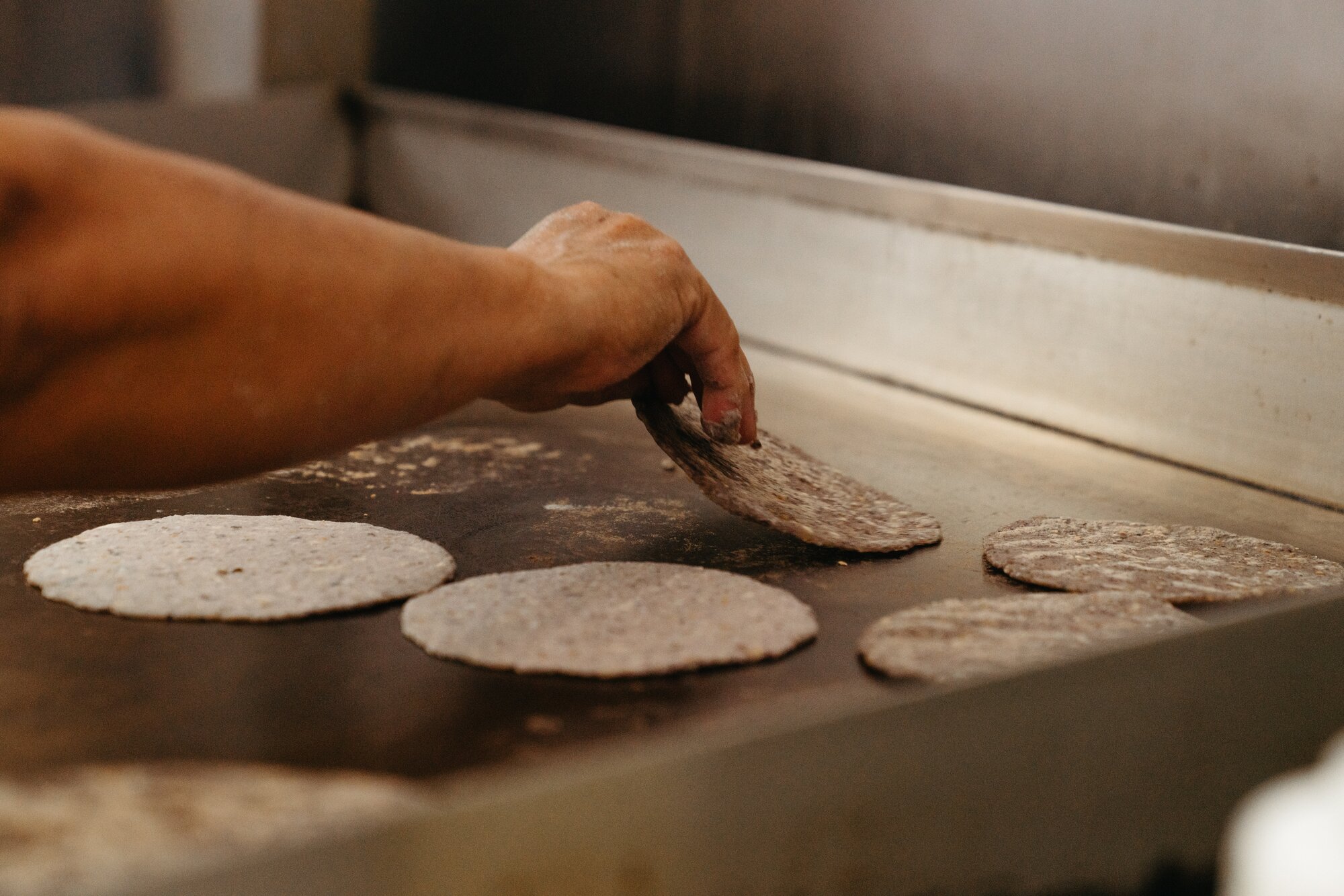
Once the tortillas are shaped, Guzmán cooks them over a flat-top griddle. A lot of her work is done by feel, intuition she developed through years of experience — and burn marks. If the masa sticks to her hand, it’s not ready to flip, Guzmán said. Once the dough starts to dry, she’ll flip the tortillas and let them cook until they are toasty. She puts the finished product in a basket with a cloth to keep them fresh. She does this hundreds of times a day.
Characterizing the rise in molinos and tortillerias in Denver as a trend would be a mistake, Rodriguez said. This isn’t the result of a viral marketing campaign. It’s the result, he said, of a generation of Mexican chefs who, after years of working in the background, “started doing their own things.”
“There's a demand for food that's not through a white lens,” Rodriguez said, “but it's more through a Mexican lens where those customers feel like, ‘I'm back in Mexico’ or ‘This tastes like something my grandma made.’”
Rocky Mountain PBS journalists Carly Rose and Adrian O’Farrill contributed reporting to this story.
Based on facts, either observed and verified firsthand by the reporter, or reported and verified from knowledgeable sources. To read more about why you can trust the journalism of Rocky Mountain PBS, please visit our editorial standards and practices page.