
Q&A: The interns who spent their summer navigating the Aspen Acres Fire
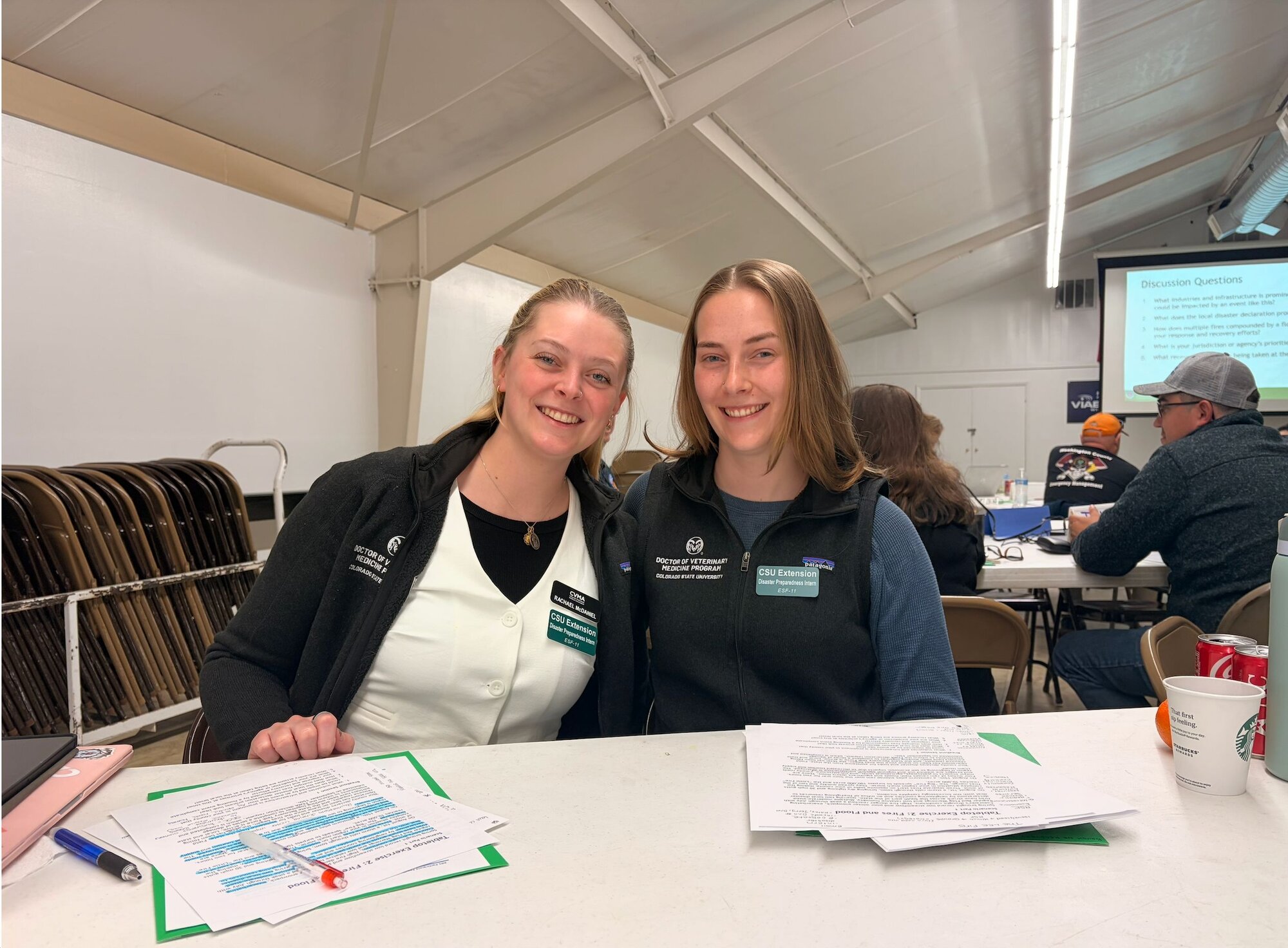
PUEBLO, Colo. — Colorado State University begins its fall semester this week, meaning many undergraduate students are wrapping up summer internships.
That includes Madison Greves and Rachael McDaniel, two veterinary students who interned with the CSU extension office to learn about animal disaster preparedness.
Greves and McDaniel hit the ground running. When the Aspen Acres Fire began to burn in early July, the extension office deployed the students to Pueblo, where they both experienced hands-on animal emergency response like checking in evacuated people and their animals to the temporary housing at the Colorado State Fairgrounds in Pueblo, tending to animal injuries from the fire and trying to sooth animal-owners anxieties and meet their basic needs like providing food and water.
As of August 24, the Aspen Acres Fire has burned more than 102,000 acres and is 77% contained.
Rocky Mountain PBS sat down with Greves and McDaniel to reflect on their summer experiences.
This conversation has been edited for length and clarity.
Rocky Mountain PBS: What were your expectations going into the internship and how did it change throughout the summer?
Madison Greves: We anticipated focusing primarily on educational outreach for producers across the state on, large animals, disaster preparedness.
It certainly evolved into, like, a masterclass in active disaster administration, state level collaboration and leadership and of course, the outreach that we had initially expected.
We were actually participating in an event with the state on the day that we got a formal request to deploy to Aspen Acres.
And it was actually just that night, like after the event that was, that went to like 4 p.m. We ended up just driving down there that night, got there pretty late to the fairgrounds, and from there we started our response. So it was somewhat unexpected. I mean, obviously we had both been spending our summer watching the Watch Duty app very closely.
Every time we'd see a new fire I’d say, “Rachel, did you see this?” So there was a small inkling of me that expected to probably be deployed to that. So once that happened that night, we were looking forward to being out there.
RMPBS: Walk me through how you were feeling the moment you heard about the Aspen Acres Fire, knowing that you might be deployed to this place.
Rachel McDaniel: We were sitting in a meeting and everybody was kind of talking about it.
The CART [Community Animal Response Team] team has been deployed, and Madison and I were just kind of sitting there and we're like, okay, this might be our chance to actually get boots on the ground and go out there and really help.
And so I was a little bit nervous just because I'd never done a lot of veterinary care with large animals. My experience has been mainly with large animal husbandry and then emergency and critical care, small animals.
But I really like organized chaos and that's what this was.
Just seeing that whole community come together to it, I think made it even more impactful for us.
MG: I remember hearing that there was like a suspected human caused fire in Pueblo County. We're in a record breaking drought right now. So immediately my thought was, this is going to get really bad really fast.
So I was feeling nervous but excited. But I felt prepared. Part of my degree is in emergency management. It's like on paper and in textbooks, I know how to go out and do this, but this is my first time actually going out and doing it.
In my head, I was reviewing, you know, what's the incident command structure? Who do I report to? I don't want to step on any toes. So what will my role be? I remember racing through all of those thoughts and that continued on my drive down there where I was just reviewing everything.
And then there was like 20 minutes before I got to the [Colorado State] Fairgrounds that I just started pumping some Public Enemy in my car, getting pretty stoked because I think I was excited to go out and help.
RMPBS: What do animal evacuations actually entail? Can you walk me through the process?
MG: Rachel and I, we were initially sent to the emergency operations center during the Aspen Acres Fire.
There was a specific group out of the Pueblo CART team that did rescue specifically. So that's a group of trained individuals that are allowed to cross that line where normal civilians cannot and go rescue large animals. So there was a group of individuals doing that specifically. Rachel and I did not go up close to the fire.
What that would look like is a group who are trained in animal behavior and they have trailers, large horse trailers available. And then they would be able to shuttle those animals on to the trailer to get them out of there.
But a lot goes into large animal evacuee action, especially because these are prey animals. So we have to consider how we approach them and how we behave around them. But some of the biggest things to consider in large animal evacuation are the availability of trailers.
From what I've learned here in the state, a lot of producers don't actually own their own trailers, but instead know someone who does. So having that network pre-established and having contacts, you could ask to borrow or use their trailer is incredibly important.
Also mapping out your evacuation plan and making alternative routes, because during disasters like the Aspen Acres fire, if a bridge goes out, if a road closes, that might be the only route that you were anticipating getting out. So you need to create alternative pathways.
And especially with large animal evacuations, these trailers can cause a great amount of traffic congestion. So if producers can find routes that aren't going to congest, normal civilian traffic to that's that's very crucial. And obviously there's a lot that goes into preparing for a large animal evacuation plan, like having go kits ready with food, water, medical supplies, fly spray, stuff like that.
RM: Another thing we realized was that a lot of people did not have their records with them. So like their brand inspection paperwork, their vaccine statuses, that was all left behind. And so part of what we did coming out of this was we made an all hazards preparedness folder that you put everything in, you keep it in your trailer, keep it in your truck.
But our main role from the evacuation standpoint was we would be at the intake line and Madison and I would go through and be like, okay, everybody looks good and healthy, we can get them in a pen.
And then we obviously caught a handful of heat stress patients. And then, like, if we saw any obvious, like, abrasions or lacerations, burns stuff like that, we'd get them separated off and then have the veterinarian on site come with us, and we would treat and figure out what to do next from there.
RMPBS: You spoke to the animal side. What did you notice about some of the folks who were coming through the intake line?
MG: The psychological toll of that, like this is incredibly massive and it's further mediated by the human animal bond.
Even if we look at past events like Hurricane Katrina… [many people who] refused to evacuate did so because they did not want to leave their pets or their animals. And many returned prematurely to save them, which ended up risking human lives.
And at Aspen Acres our big priority was alleviating the strain for both the people and the animals. But there were certainly many flustered individuals that came in and the one thing that really stood out to me was actually all of them that I can think about as even though they were flustered. My goal with psychological first aid is to be like, just focus on what they need, like ground level.
Once I feel like we were able to establish that baseline of just comfortability and like, you're here, you evacuated your animals, you did it. Then I would ask, like, “What's special about your animals? Tell me about it.” And, like, although these three people were incredibly flustered and anxious, they would all tell me something very silly or personable about their animal.
RM: It was just getting them to tell us something that made them smile. And, I mean, every single person coming through that intake line was so incredibly thankful for everybody being there and just being like, come sit down. We have food, we have water, go grab something. We'll put your animals where they need to go.
Take a second. It's okay. Like you, you are safe now. Your animals are safe. Just take a deep breath.
RMPBS: What was something unexpected or surprising that you learned this summer?
MG: Something I really learned was the diversity of stakeholders that align to manage an agricultural or a complex animal disaster. Branding inspector, Sheriff's Department, veterinarians, veterinary technicians, public health experts, social workers all come together to deliver a coordinated response.
That's one thing that I really learned is how many and how diverse these networks are during disasters, because obviously my scope has primarily been veterinary. So getting to work with, with social workers or brand inspectors has been really unique.
RM: I think what really surprised me was seeing how fast the whole community came together.
Even on the — it was like day 3 or 4 — we had dozens of calls of people just like, “I want to help. I have space on my pasture. If you need other animals to get out of there, need more room, or I have connections with Costco and Walmart, how can I help you guys? What can I do?”
Or we had a guy from Oklahoma call was like, “hey, I have a fleet of trailers, can we help you guys?”
RMPBS: What sticks out to you the most about your summer internship that we haven't talked about?
MG: I would love to touch on just how important this field is, so I believe we need to stop treating veterinary disaster medicine as its own niche specialty because it really is essential public health, infrastructure.
And with our changing climate, obviously these disasters are going to continue to increase in frequency and intensity. And the reality is, like likely every veterinary student and every practicing clinician will experience or be adjacent to a disaster at some point in their career.
So I would really encourage anyone in the veterinary sector to get involved in disaster medicine, whether that's just reading up on incident command or reading reports of previous veterinary disasters. I think that's really crucial.
An interview to provide a single perspective, edited for clarity and obvious falsehoods. To read more about why you can trust the journalism of Rocky Mountain PBS, please visit our editorial standards and practices page.