
New statewide prison newspaper program gives a voice to Colorado’s incarcerated
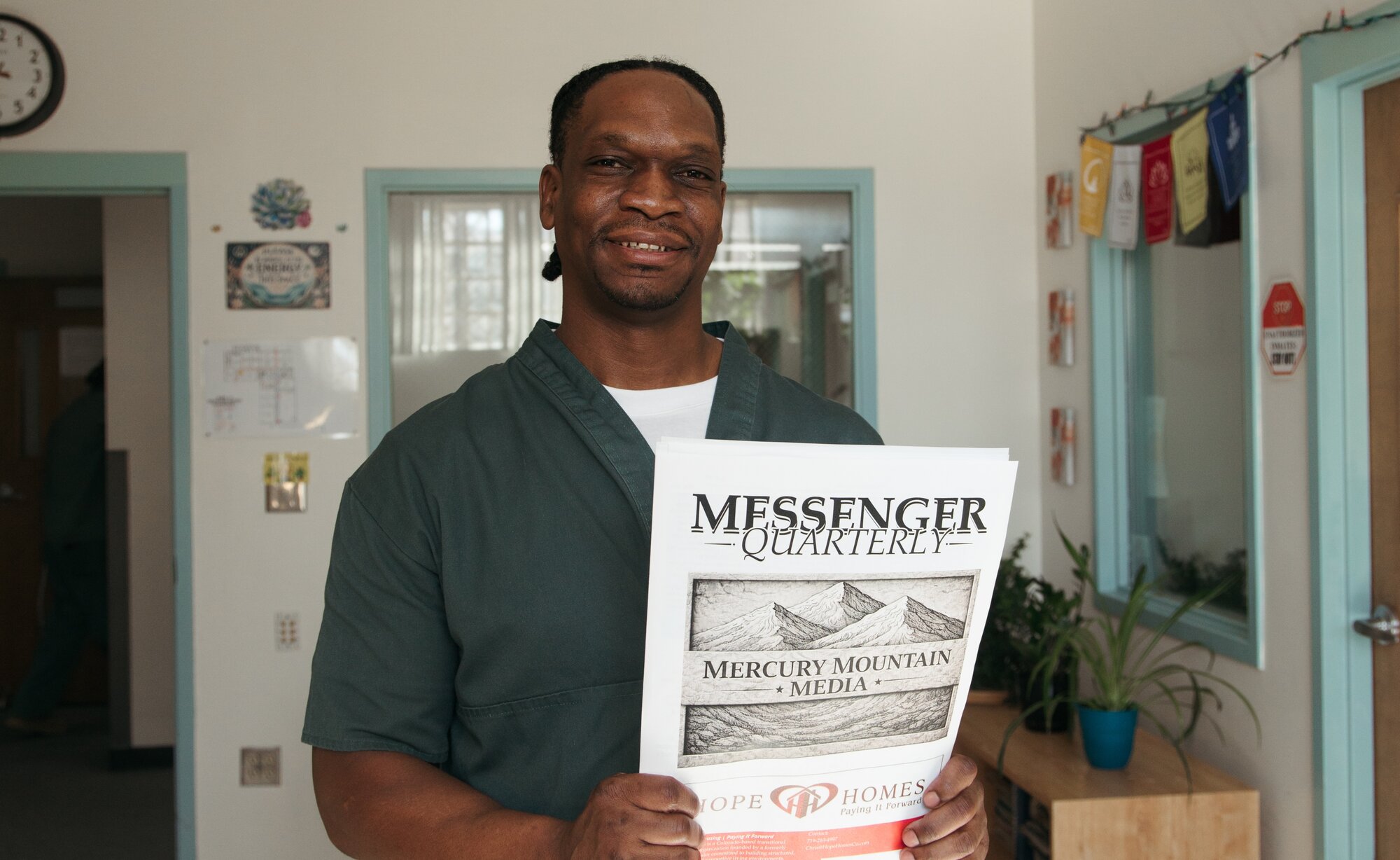
CAÑON CITY, Colo. — The hum of plug-in fans — picking up slack for the struggling air conditioning — filled the silent classroom inside Fremont Correctional Facility. Nine men and one woman sat quietly around the table, pausing their conversation to read the printed-out poem in front of them.
Daniel Sopiwnik spoke first, prompting his peers to share their thoughts about the piece, what message they took away and what snippets stood out to them. The poem is one of 300 written pieces submitted by incarcerated people in Colorado for inclusion in the state’s new statewide prison newspaper, Messenger Quarterly.
The quarterly newspaper, which published its first issue in May, is a product of Mercury Mountain Media, the publication arm of Unbound Authors, a Colorado nonprofit that provides writing workshops inside correctional facilities.
Anyone incarcerated in one of Colorado’s 21 prisons can submit a piece of writing for publication — news reports, personal essays or creative pieces. The digital editions are accessible to people inside and outside the prisons. Out of 22 active prison newspapers in the U.S., Messenger Quarterly is the only one in the Mountain West, according to the Prison Journalism Project’s 2024 directory.
“Very often when people become incarcerated, there’s a level of, I don’t want to say despondency, but … a lot of the times we have to process a lot when we come into these spaces, and they’re very difficult to process. So allowing people to have a voice again is probably the impact that I see the biggest in this space,” said Sopiwnik, who is serving a life sentence with eligibility for parole at Fremont Correctional Facility in Cañon City.
“They feel connected to something, maybe for the first time in decades. And I think having that opportunity to be seen and heard outside of the walls of prison is just, it’s almost indescribable,” he said.
Sopiwnik is part of the publication’s development team at Fremont Correctional Facility. These incarcerated “developers” review submissions and work with authors to get the piece ready for publication. Currently, about 35 incarcerated people across nine facilities work on Messenger Quarterly and Mosaics, Mercury Mountain Media’s creative arts magazine which includes fiction writing, art and poetry.
Sopiwnik trains development team members on how to read with a critical eye and communicate with authors. Sopiwnik briefly worked on The Inside Report, a statewide prison newspaper supported by the University of Denver Prison Arts Initiative. He is credited in the final, unpublished issue of The Inside Report, which stopped production in 2023 when the contract between DUPAI and the Colorado Department of Corrections ended.
JoyBelle Phelan, executive director and co-founder of Unbound Authors, started Mercury Mountain Media (and with it, Messenger Quarterly) to bring a newspaper program back to Colorado’s prisons. Phelan worked on The Inside Report during her incarceration and after her release.
“I just had in the back of my brain, ‘How do we bring it back?’ Because I knew what it had done for me,” Phelan said.
“There is this idea, Glenn Martin always says this, that the people closest to a problem are usually the best available to answer those questions … The idea is you are not parachuting in and writing a story on that population. The people who should be writing those stories are the people who are living it.”
Phelan and editor-in-chief William Coney, who is incarcerated at Fremont Correctional Facility serving life without parole, ultimately decide on which submissions are included in each issue, depending on how they fit that issue’s general theme. The inaugural issue, which included 36 contributors, focused on closing the chapter of The Inside Report and looked ahead to the new publication’s possibilities.
The CDOC reviews a final draft of each issue and can omit stories deemed unsafe for publication. This includes stories that deal with active lawsuits, that might have a negative impact on victims or that pose a security risk, like promoting an escape plan or otherwise jeopardizing staff safety.
Coney, who worked as senior editor of layout at The Inside Report, said he plans to keep a few back-up stories on deck in case he needs to quickly fill a spot left by a nixed article.
“We might be out to explain why things are tough, but not to hurt anything because everybody's doing what they can in this environment. Definitely the department's behind us, and we realize that,” Coney said.
Fremont Correctional Facility served as the previous headquarters for The Inside Report, so it has an established culture of support for a newspaper program, Phelan said. The incarcerated members of Mercury Mountain Media’s leadership team — Sopiwnik, Coney and Dotson — are all at that facility.
Right now, the incarcerated people working on the publication are not paid. For three years, Unbound Authors operated inside Colorado facilities as a volunteer program. This fiscal year, the nonprofit is in the final stages of executing a $25,000 annual contract with the CDOC. The contract supports Unbound Authors’ writing labs, educational courses and the quarterly publication.
“Their investment and their belief in what we're doing is really gratifying,” Phelan said. “While we might have a small contract with the department, it is nowhere near enough.” Unbound Authors is still seeking other funding sources to be able to continue its work inside.
Phelan and the development teams are deep in production for the second issue of Messenger Quarterly and hope to publish by September. Coney already decided on the theme for the next issue: “Who Cares?”
The cheeky title — which Phelan said is very on-brand with Coney’s sense of humor — will highlight mentors, volunteers and staff who have shown their care for what’s happening inside Colorado’s facilities.
Based on facts, either observed and verified firsthand by the reporter, or reported and verified from knowledgeable sources. To read more about why you can trust the journalism of Rocky Mountain PBS, please visit our editorial standards and practices page.