Sign up for our newsletter

Made in Marble: The unexpected story of a town at the end of a Colorado road
share
NEWS

MARBLE, Colo. — Just like it holds up the dining deck of the town’s only restaurant, the Yule marble of Colorado has buttressed the tiny town of Marble on the state’s Western Slope. 

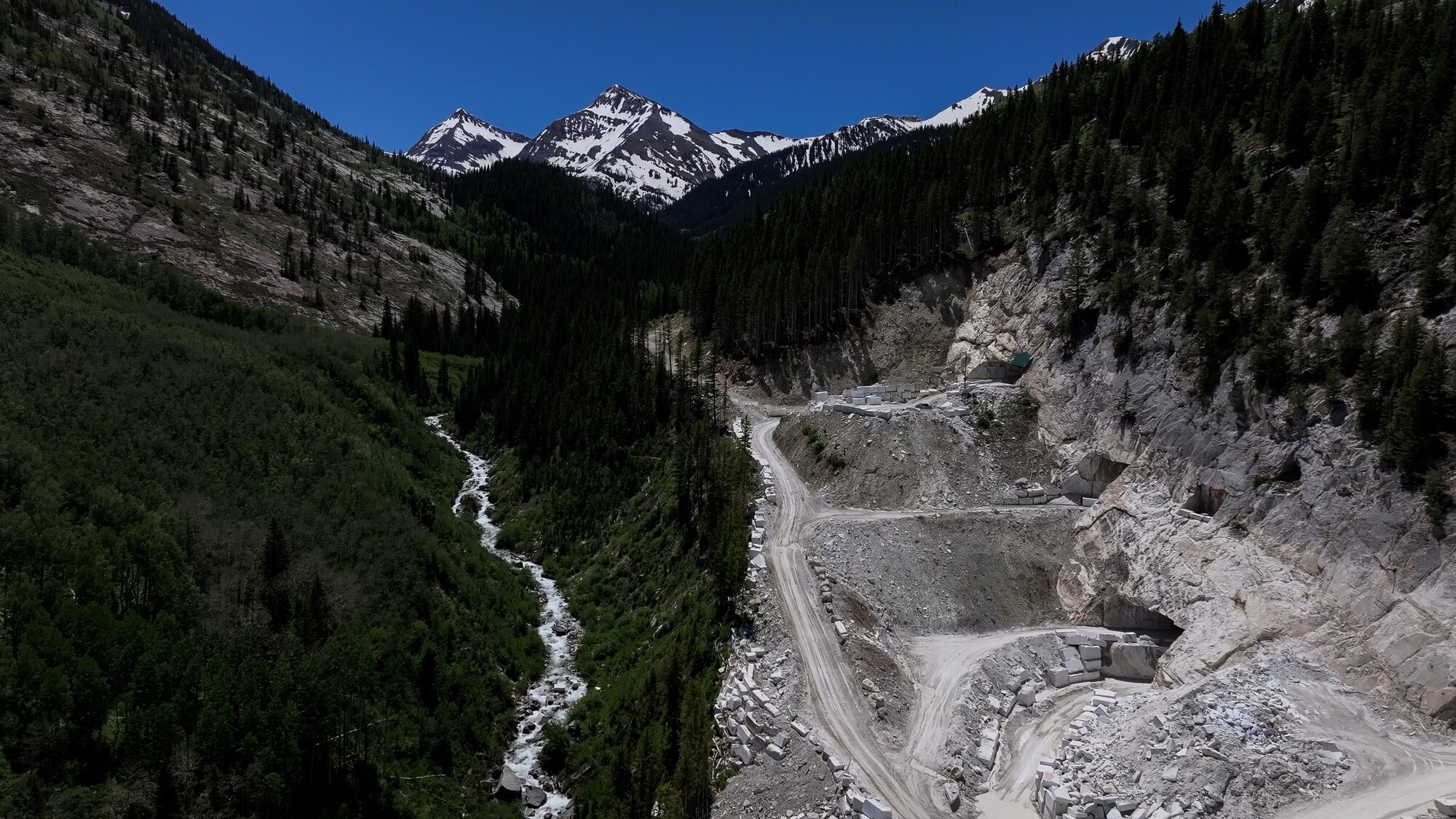
Colorado’s Yule marble, a blindingly-white stone that’s 99.5% pure calcite — transformed limestone made of decomposed and compressed ancient marine animals formed millions of years ago — is found in exactly one spot in the Centennial State: a deposit in the Elk Mountains nestled along the Yule Creek, 30 miles past Carbondale and not far from some of the state’s grandest summits, including Capitol Peak, Snowmass Mountain and the Maroon Bells. 

Kimberley Perrin, the director of the Marble Historical Society and a former employee of the town’s quarry, was awestruck when she moved to Marble about three decades ago.

“A lot of people will stop and talk and say, ‘this is like heaven.’ And I just go, ‘I agree,’” Perrin said. “The quietness, the birds… the security, the beauty of looking up at the stars at night.” 

Yule marble’s near-perfection has earned it a spot in some of the most hallowed landmarks in the United States. A tourist in Washington, D.C., will find the marble in the columns at the Lincoln Memorial colonnade and in the nearby Arlington Cemetery at the Tomb of the Unknown Soldier. 

The tale of Marble, and the quarry four miles away that serves as the town’s namesake, captures the spirit of the rugged Colorado settlers and enterprising, complex characters of American history at large. The town is the subject of “Colorado Experience: Made in Marble,” a Rocky Mountain PBS documentary airing Aug. 27.

The First Marble Residents

Before people sought stone in Marble, they sought food. The native people of the Ute tribe spent summers in the area and hunted game for hundreds of years prior to the arrival of white settlers. 

The Utes first encountered Spanish missionaries in 1765 before settlers hunting for beaver pelts became more common in the 1800s. Settlers and the Utes clashed over the next century as the newcomers took land and forced their beliefs and ways of life on the native people, which culminated in the Meeker Massacre in 1879. Shortly thereafter, federal forces finished the effort to permanently remove the Ute people from their lands in western Colorado.

With the Ute people gone, more settlers and prospectors seeking silver and gold traveled to the area that is now Marble. According to longtime Western State Colorado University professor and historian Duane Vandenbusche, author of “Marble, Colorado: City of Stone,” lore has it that the last remaining Utes placed a curse on the valley so that “any enterprise attempted by the white man would be doomed to failure.”

That curse did come to pass at times, but not until some enterprises succeeded first.

Marble, the town

Marble is where many things run out — the paved road, cell phone service and the Crystal River Valley before it climbs into the mountains.

A visitor on the way to the nearby Crystal Mill might blink and miss the one-third of a square mile town of Marble, which is composed mostly of a smattering of houses lodged in ponderosa pine trees. 

Here, the near-perfect white rock is ubiquitous, interwoven so deeply into the place’s history and landscape that a visitor could hardly notice it. 

The stone is intentionally and indiscriminately everywhere. It lines driveways, supports mailboxes perched atop chunks near the roadside and peppers the Crystal River with massive throwaway blocks discarded long ago near the once-was railroad. 

Vandenbusche said “the more I learned about [Marble], the more I liked it,” and so he wrote a history of his home, which he called “the most unique town in the world.”

“I can't think of any other town in the world that is based on marble, the stone,” Vandenbusche said.

Marble’s story follows that of other boom-and-bust mining towns in Colorado that rode the high of a mineral deposit for decades before plummeting back down to earth. 

Now, its year-round population stands at 133, according to the U.S. Census Bureau. Its population reached its zenith during the quarry’s boom in 1910 at 782 people before falling to just five in 1960. Historians estimate the true peak to have been much higher, in the thousands. Stepping off the railroad at that time, visitors would have seen hundreds of homes in a bustling town. 

Marble appeared then as Western towns in movies do — a buzzing and dusty main street, post office, six saloons, five general stores and a single jail cell. 

One hundred fifteen years ago, the quarry was largely staffed by Italian expats, who the quarry owners sought for their expertise in quarrying marble. But at that time, Italians were among those who experienced violent discrimination.

Colorado had documented lynchings of Italians in the 1890s, including the case of the retribution killings of five men in Walsenburg in 1895. The events even prompted a formal protest from the Italian government. 

Yet in Marble, Italians worked alongside Americans, Greeks and others to labor over the simple task of removing stone from the mountainside. 

Despite its rough-and-tumble potential, there aren’t many recorded incidents of violence in town.

“The people were pretty busy,” Perrin said. “They didn't have a lot of time to get into trouble.”

The town may have formed because of the quarry nearby, but today most people come for nature. Other than a feeble effort to build a ski area nearby in the early 1970s that quickly failed, no major tourism development has occurred in Marble. 

Over the years, Marble changed from a working town to an empty town to a leisure town, with many property owners in the area now maintaining modest vacation homes. Locals rave about the sense of community. The population is barely in the triple digits; most people know one another. 

“To this day, I have never had to lock the door on my house,” Perrin said.

The town has one restaurant, Slow Groovin’ BBQ, and one cafe. Ryan Vinciguerra owns both. He is also the mayor of Marble. In the lawn of the barbecue restaurant sits a discarded, curved chunk of marble that was once hewn for the Lincoln Memorial. A number of such pieces are found around town.
Vinciguerra has been mayor for about seven years. The job is something between a CEO and camp counselor. Every big problem goes through him and many small disputes do, too. 

“My biggest role is probably mediator,” Vinciguerra said.

Like many others, Vinciguerra visited the valley one day and, captured by its beauty and “all the colorful characters,” never really left. 

“Marble is magical. I hate to sound cliche, but it is,” Vinciguerra said.

If he’s not grading a dirt parking lot and checking for potholes around town, he’s standing over a giant barbecue grill, smoke pouring out like a train engine that once hauled people into — and rock out of — Marble. 
As town grillmaster, maintaining a workforce, convincing suppliers to deliver in the middle-of-nowhere and establishing credibility are hurdles. The business provides a few dozen beds as workforce housing at affordable rates to help employees stick around.

Being mayor requires extra patience.

“I like to say that Marble, as small a town as it is, has expensive problems,” Vinciguerra said. “Road maintenance and old record organization and ordinances… anything from barking dogs to being overrun by ATVs to, you know, managing our parks.”

“It's pretty slow moving when it comes to getting things done.”

When Vinciguerra considers Marble’s future, he imagines it to look a lot like it is now. A small group of children go to school at the K-8 Marble Charter School, and more travel to nearby Carbondale. Vinciguerra said that young families have moved into town recently. 

“People love Marble the way that it is, so you don't have to change too much,” Vinciguerra said. “What you see is what you're going to get.”
The Quarry
The Yule marble quarry, opened in 1885, is up a dirt road less than four miles from town. Today, it’s called the Pride of America Mine.

In 1873, a geologist named Sylvester Richardson was the first settler to discover the white marble. About a year later, a prospector named George Yule also found it, and it was named Yule marble.

But it was John Osgood who had the most successful early commercial enterprise in Marble. Osgood’s Yule Creek White Marble Company displayed a piece of stone at the Chicago World's Fair in 1893 — the same fair where electric lighting dazzled visitors, the Ferris Wheel debuted, and Pabst Blue Ribbon beer established its popularity — and orders followed. 

To pick up a cubic foot of Yule marble is to hoist 170 pounds. To touch it in either sun or shadows is to feel coolness, the rock’s reflective color making it 10-15 degrees colder than the surrounding air temperature. To crush it is to channel more than 14,000 pounds of pressure per square inch. 

You may find it with golden streaks (Calcatta Golden), grey streaks (Aspen Grey), mixed with green or close to pure white (Statuario Colorado). It’s dazzling. 
Asked what he thinks of the quarrymen of the early 1900s, current quarry master Stefano Mazzucchelli, an Italian from Carrara, replied: “They were crazy.”

“What they did a century ago, it was amazing,” Mazzucchelli said. “You imagine without the machine… We can't do that right now. We are easy, you know, we work with the perfect machine and we make it a job simple.”

Quarry operations at the start were almost comically precarious. 

Workers skied up the road in wintertime, dodging avalanches that frequented 14 paths on the way (avalanches are still a problem). Horses first carried the rock down on carts before the introduction of electric trolleys (which regularly ran off the mountainside tracks). The early quarrymen lifted colossal rocks hundreds of feet in the air through portals with nothing but rudimentary cranes. They used steam to break rock pieces off because they couldn’t cut the stone. Some workers walked to the quarry from lodging in town, and some stumbled in from the shantytown that stood near its entrance, where they lived without amenities year-round at 9,000 feet in elevation.
Gary Bascom, who was a manager at the quarry before opening Abstract Marble and Gift Shop, reflected on the doggedness of the workers back then.

“The people that started this part of the country in Colorado and Marble, those were some tough people,” Bascom said. “Very determined with what they wanted to do in life.”

But even with that simpler technology, the rugged quarrymen managed to supply the rock for some of America's most iconic landmarks in Washington, D.C., including the Lincoln Memorial and the Tomb of the Unknown Soldier. 

The Lincoln Memorial Commission established by the U.S. Congress decided in 1913 that using arguably the best rock anywhere within the country’s borders was worth the effort to retrieve it. 

At least 500 rail cars transported 4,130 pieces of marble to construct the Lincoln Memorial’s exterior. Its 36 columns each stand 44 feet tall and comprise 11 separate pieces.

Under two miles away sits the Tomb of the Unknown Soldier, a memorial made of a single piece of Yule marble that weighs about 56 tons, or 112,000 pounds. A replacement block for the current tomb, which has a crack running along its side, sits inconspicuously in the parking lot of the quarry office.

The stone has been used in projects in at least 26 states across the country, some closer to home. The interior floor of the Colorado State Capitol in Denver is Yule marble. The Daniels and Fisher Tower on 16th Street has it, too. Denverites may have seen Yule marble without even knowing it. 

But despite its contributions to America's heritage, the quarry fell on tough times when the world wars hit. Contracts dried up. Workers returned to Europe to fight for their home countries, sometimes against the United States. Nobody was buying marble when everybody was building bombs.

And thus the golden era of the Yule marble quarry ended. Nearly 50 years passed before anybody seriously considered the rock and whether it could make beautiful things again. 

“You can imagine any business that was closed for 50 years… it probably took us about a month and a half to actually clean the place up,” said Bascom, who helped to reopen the quarry.

It reopened in 1990 but never hit its stride, sputtering in and out of solvency until R.E.D. Graniti, an Italian company, purchased the quarry in 2011. The 15 years since have brought a revival to the quarry. 

Now, things operate so smoothly and subtly that you’d hardly know 600-800 tons of rock are excavated there each month, besides the occasional rumbling of trucks moving the SUV-sized blocks down the mountain about nine times per week.

The quarry is as cool as a refrigerator, and pure white walls tower in hundred-feet-tall rooms. Workers drive bullet-ridden military surplus Hummers through massive portals into the belly of the mountain. It’s noisy inside as quarrymen saw through rock with advanced tools. 

The average block the quarry ships weighs about 42,500 pounds, and measures 10 feet long by 5 feet wide and high. 

The mill that once stood smack in town doesn’t exist any more, but its memory does. A few columns hint at the storied history of the site as tourists wander about. The building was once a 1,700-foot-long behemoth where the marble for the Lincoln Memorial was finished before transiting to Washington. Many claim that it was the largest building on earth by volume for a time.
Now, the marble is milled in Delta.

The finished rock goes to projects around the world, from New York to Dubai. Since taking over, R.E.D. Graniti has excavated about 150,000 tons of rock. At their current pace, they estimate the 3-mile-long, 300-feet-thick marble vein will last another 100 years. 

The quarry is focused on quality and sustainability, though they could remove rock faster and likely sell more. 

“We want to move just the best,” Mazzucchelli said. “We don't want to make a lot of damage. And [it is] important that we save 100 percent of the material.”

Marble Renaissance
When locals say that Marble is “full of characters,” they’re usually referring to a cadre of eclectic artists that make their homes and art in Marble. 

There are about six sculptors in town and at least three art galleries. 

Greg Tonozzi is almost as much a fixture of the town as the marble is itself. In 1984, he bought property on the Crystal River after noticing an endless supply of discarded marble along its banks that he could use for sculptures. 

“When I first touched my first piece of marble, I felt like I was falling backwards into a black hole,” Tonozzi said. “All of a sudden, everything that I had learned, like welding and electricity and plumbing, it all came into play. And I just felt like, ‘This is for me.’”

For Tonozzi, nothing compares to the feeling of carving stone, especially by hand. It connects him to carvers of the past, from Italy to Egypt.

“People have been carving stone for thousands and thousands of years,” Tonozzi said. “It has a tendency to tie us to that ancient-ness of it. But it's also just such a challenge to try and bring beauty out of a block of stone.”

Tonozzi is not alone in his affections for carving stone. There is a growing artistic scene in Marble, its sculptors producing work renowned in places far away. In the 1980s, before the quarry even reopened, artists had begun finding rock and inspiration in the valley. 

In 1989, Madeline Wiener, at the time a sculptor and instructor in Denver, started the MARBLE/marble Stone Carving Symposium with the help of other artists, including Tonozzi. 

“I presented the concept of a workshop to the board of directors of the Art Students League of Denver,” Wiener said. “They said, ‘Make it happen, as long as it doesn't cost us one single dime or postage stamp.’”

In the first year, there were about 30 people who joined the ragtag gathering of artists.

“This whole program was all about sharing knowledge, sharing equipment, sharing this land. Friendships have happened here,” Wiener said. “In a way, we added [to] putting Marble — the town of Marble — on the map.”

Now, the symposium usually sells out all three of its 8-day sessions during July and hosts around 100 people annually. Participants from all over the world come to receive instruction and access tools as they learn to carve marble. This year marked the 37th workshop.

Rhea Turner attended the 2026 symposium at the recommendation of an art teacher friend. She hoped to carve a fountain. 

Turned said she was scared before arriving. 

“I don't camp. This is the longest that I've ever gone without air conditioning and sleeping outside,” Turner said. “I was so worried that I would just be out here alone trying to do all this stuff by myself with some people that were sort of indifferent.”

But she found the opposite to be true.

“There's so many times that I've just wanted to cry because people are just so kind and giving of themselves,” Turner said.

She finds the process of the stone chipping away and the mushroom clouds of dust that fill the air to be more than therapeutic.

“It's a spiritual experience. It's very transformative,” Turner said. “It's so beautiful to just be alone with the rock and let it tell me where I should go with the tools.”

"Colorado Experience: Made in Marble" airs Thursday, Aug. 27 on Rocky Mountain PBS, RMPBS+ and our YouTube channel.

Alexis Kikoen and Polina Saran contributed to this report.

Type of story: News
Based on facts, either observed and verified firsthand by the reporter, or reported and verified from knowledgeable sources. To read more about why you can trust the journalism of Rocky Mountain PBS, please visit our editorial standards and practices page.

Subscribe to Our Newsletters

Get trusted Colorado stories, programs, and events from Rocky Mountain PBS straight to your inbox.

Set Your Preferences >

Over a million Coloradans turn to Rocky Mountain PBS to discover provocative and inspiring local, national and international programming; find diverse viewpoints; score front row center seats to world-class performances; and experience lifelong learning opportunities every month.

Contact with us

Contact

Audience Services

Mail

Address

Buell Public Media Center

2101 Arapahoe St.

Denver, CO 80205

Legal

Thank you to the Buell Foundation, Bonfils Stanton Foundation and Koelbel & Company.

This site uses cookies for continuous music streaming.

© 2024, All Rights Reserved