
Made in Marble: The unexpected story of a town at the end of a Colorado road
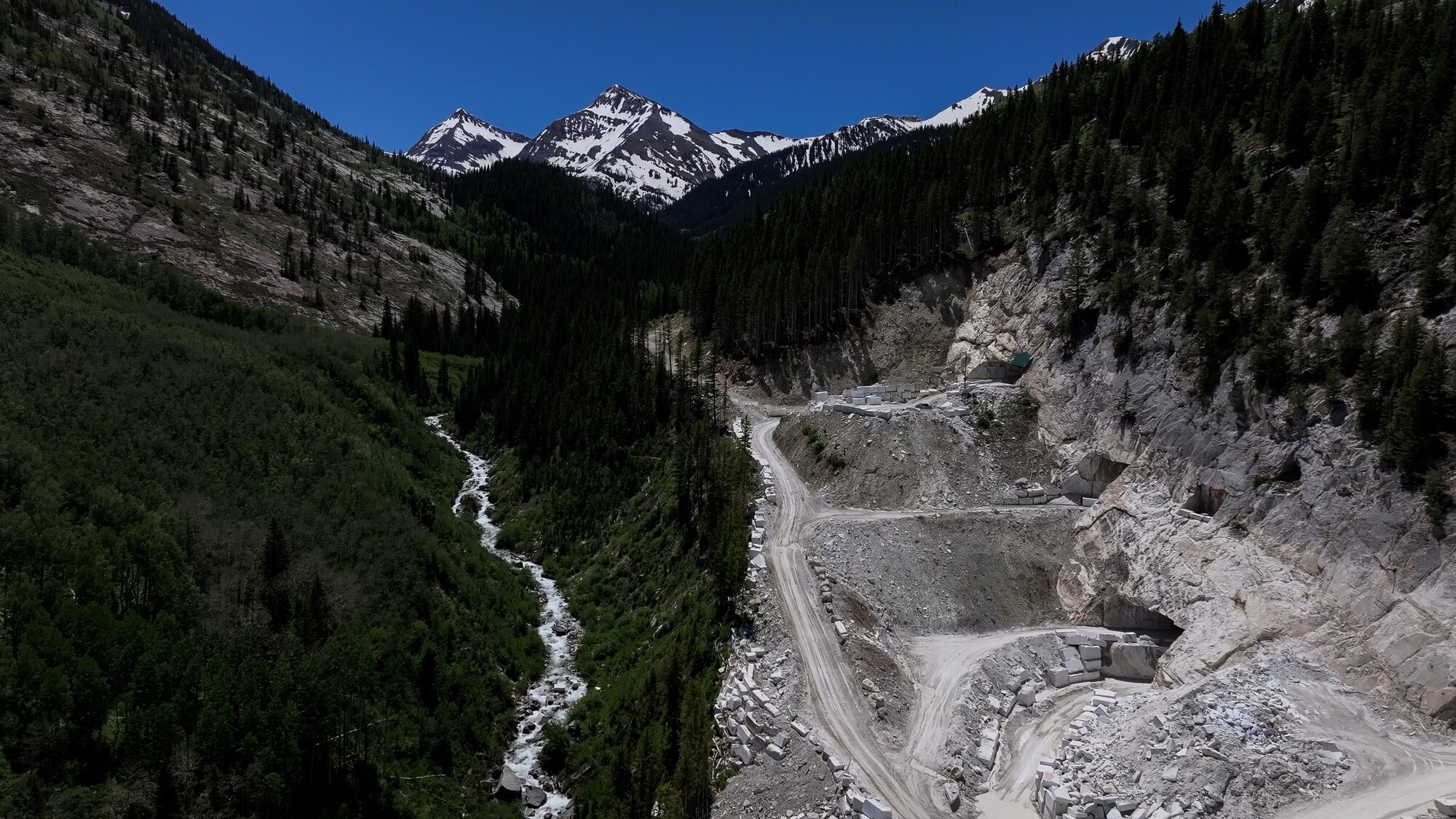
MARBLE, Colo. — Just like it holds up the dining deck of the town’s only restaurant, the Yule marble of Colorado has buttressed the tiny town of Marble on the state’s Western Slope.
Colorado’s Yule marble, a blindingly-white stone that’s 99.5% pure calcite — transformed limestone made of decomposed and compressed ancient marine animals formed millions of years ago — is found in exactly one spot in the Centennial State: a deposit in the Elk Mountains nestled along the Yule Creek, 30 miles past Carbondale and not far from some of the state’s grandest summits, including Capitol Peak, Snowmass Mountain and the Maroon Bells.
Kimberley Perrin, the director of the Marble Historical Society and a former employee of the town’s quarry, was awestruck when she moved to Marble about three decades ago.
“A lot of people will stop and talk and say, ‘this is like heaven.’ And I just go, ‘I agree,’” Perrin said. “The quietness, the birds… the security, the beauty of looking up at the stars at night.”
Yule marble’s near-perfection has earned it a spot in some of the most hallowed landmarks in the United States. A tourist in Washington, D.C., will find the marble in the columns at the Lincoln Memorial colonnade and in the nearby Arlington Cemetery at the Tomb of the Unknown Soldier.
The tale of Marble, and the quarry four miles away that serves as the town’s namesake, captures the spirit of the rugged Colorado settlers and enterprising, complex characters of American history at large. The town is the subject of “Colorado Experience: Made in Marble,” a Rocky Mountain PBS documentary airing Aug. 27.
The First Marble Residents
Before people sought stone in Marble, they sought food. The native people of the Ute tribe spent summers in the area and hunted game for hundreds of years prior to the arrival of white settlers.
The Utes first encountered Spanish missionaries in 1765 before settlers hunting for beaver pelts became more common in the 1800s. Settlers and the Utes clashed over the next century as the newcomers took land and forced their beliefs and ways of life on the native people, which culminated in the Meeker Massacre in 1879. Shortly thereafter, federal forces finished the effort to permanently remove the Ute people from their lands in western Colorado.
With the Ute people gone, more settlers and prospectors seeking silver and gold traveled to the area that is now Marble. According to longtime Western State Colorado University professor and historian Duane Vandenbusche, author of “Marble, Colorado: City of Stone,” lore has it that the last remaining Utes placed a curse on the valley so that “any enterprise attempted by the white man would be doomed to failure.”
That curse did come to pass at times, but not until some enterprises succeeded first.
Marble, the town
Marble is where many things run out — the paved road, cell phone service and the Crystal River Valley before it climbs into the mountains.
A visitor on the way to the nearby Crystal Mill might blink and miss the one-third of a square mile town of Marble, which is composed mostly of a smattering of houses lodged in ponderosa pine trees.
Here, the near-perfect white rock is ubiquitous, interwoven so deeply into the place’s history and landscape that a visitor could hardly notice it.
The stone is intentionally and indiscriminately everywhere. It lines driveways, supports mailboxes perched atop chunks near the roadside and peppers the Crystal River with massive throwaway blocks discarded long ago near the once-was railroad.
Marble appeared then as Western towns in movies do — a buzzing and dusty main street, post office, six saloons, five general stores and a single jail cell.
One hundred fifteen years ago, the quarry was largely staffed by Italian expats, who the quarry owners sought for their expertise in quarrying marble. But at that time, Italians were among those who experienced violent discrimination.
Colorado had documented lynchings of Italians in the 1890s, including the case of the retribution killings of five men in Walsenburg in 1895. The events even prompted a formal protest from the Italian government.
Yet in Marble, Italians worked alongside Americans, Greeks and others to labor over the simple task of removing stone from the mountainside.
Despite its rough-and-tumble potential, there aren’t many recorded incidents of violence in town.
“The people were pretty busy,” Perrin said. “They didn't have a lot of time to get into trouble.”
The Quarry
At least 500 rail cars transported 4,130 pieces of marble to construct the Lincoln Memorial’s exterior. Its 36 columns each stand 44 feet tall and comprise 11 separate pieces.
Under two miles away sits the Tomb of the Unknown Soldier, a memorial made of a single piece of Yule marble that weighs about 56 tons, or 112,000 pounds. A replacement block for the current tomb, which has a crack running along its side, sits inconspicuously in the parking lot of the quarry office.
The stone has been used in projects in at least 26 states across the country, some closer to home. The interior floor of the Colorado State Capitol in Denver is Yule marble. The Daniels and Fisher Tower on 16th Street has it, too. Denverites may have seen Yule marble without even knowing it.
But despite its contributions to America's heritage, the quarry fell on tough times when the world wars hit. Contracts dried up. Workers returned to Europe to fight for their home countries, sometimes against the United States. Nobody was buying marble when everybody was building bombs.
And thus the golden era of the Yule marble quarry ended. Nearly 50 years passed before anybody seriously considered the rock and whether it could make beautiful things again.
“You can imagine any business that was closed for 50 years… it probably took us about a month and a half to actually clean the place up,” said Bascom, who helped to reopen the quarry.
It reopened in 1990 but never hit its stride, sputtering in and out of solvency until R.E.D. Graniti, an Italian company, purchased the quarry in 2011. The 15 years since have brought a revival to the quarry.
Marble Renaissance
Tonozzi is not alone in his affections for carving stone. There is a growing artistic scene in Marble, its sculptors producing work renowned in places far away. In the 1980s, before the quarry even reopened, artists had begun finding rock and inspiration in the valley.
In 1989, Madeline Wiener, at the time a sculptor and instructor in Denver, started the MARBLE/marble Stone Carving Symposium with the help of other artists, including Tonozzi.
“I presented the concept of a workshop to the board of directors of the Art Students League of Denver,” Wiener said. “They said, ‘Make it happen, as long as it doesn't cost us one single dime or postage stamp.’”
In the first year, there were about 30 people who joined the ragtag gathering of artists.
“This whole program was all about sharing knowledge, sharing equipment, sharing this land. Friendships have happened here,” Wiener said. “In a way, we added [to] putting Marble — the town of Marble — on the map.”
Now, the symposium usually sells out all three of its 8-day sessions during July and hosts around 100 people annually. Participants from all over the world come to receive instruction and access tools as they learn to carve marble. This year marked the 37th workshop.
Rhea Turner attended the 2026 symposium at the recommendation of an art teacher friend. She hoped to carve a fountain.
Turned said she was scared before arriving.
“I don't camp. This is the longest that I've ever gone without air conditioning and sleeping outside,” Turner said. “I was so worried that I would just be out here alone trying to do all this stuff by myself with some people that were sort of indifferent.”
But she found the opposite to be true.
“There's so many times that I've just wanted to cry because people are just so kind and giving of themselves,” Turner said.
She finds the process of the stone chipping away and the mushroom clouds of dust that fill the air to be more than therapeutic.
“It's a spiritual experience. It's very transformative,” Turner said. “It's so beautiful to just be alone with the rock and let it tell me where I should go with the tools.”
"Colorado Experience: Made in Marble" airs Thursday, Aug. 27 on Rocky Mountain PBS, RMPBS+ and our YouTube channel.
Alexis Kikoen and Polina Saran contributed to this report.
Based on facts, either observed and verified firsthand by the reporter, or reported and verified from knowledgeable sources. To read more about why you can trust the journalism of Rocky Mountain PBS, please visit our editorial standards and practices page.